The most valuable task of a real team is when they make decisions together. Teams are almost always better at this than individuals — except in very simple cases where an individual can decide quickly and move on. In fact, research has shown that in “simple” situations, groups can sometimes make worse decisions than a single person.
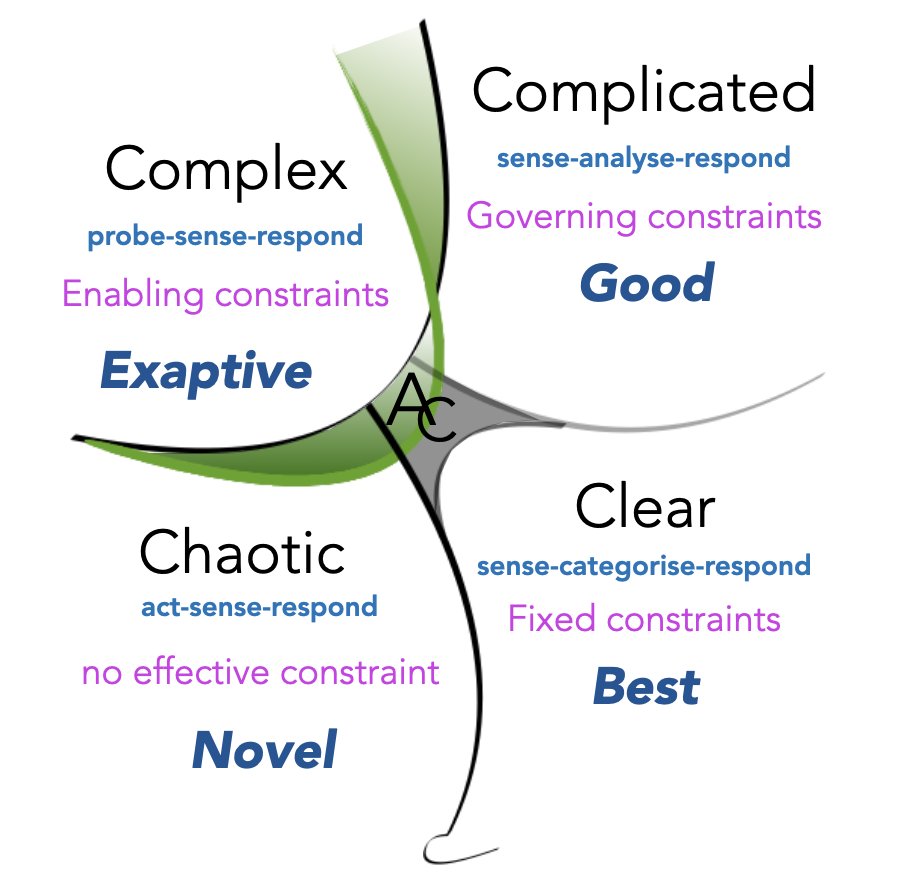
That’s why it’s so important to understand the type of decision you’re facing. Many teams fall into the trap of approaching every decision in the same habitual way. One of the best tools I’ve found to help teams make skillful decisions is the Cynefin framework, developed by Dave Snowden. It outlines five domains, each requiring a different approach.
The domains in action
- A/C, Disorder (or Confused): When it’s unclear what type of decision you’re facing, the team is in the Disorder domain. For example, a group of engineering managers might try to design a leadership development program by applying their technical expertise. But leadership development is a complex issue — not a simple engineering problem — so their habitual approach is misplaced.
- Clear / Obvious (Simple): Best practice applies here. For example, once the walking paths through an automated factory are clearly marked, there’s no need for a team to debate. Workers simply follow the pathway, just as drivers follow the rules of the road (on the right side — unless you’re in the UK, of course).
- Complicated: Good practice is needed. For instance, designing a car part shouldn’t be left to one engineer. It requires collaboration between engineering, purchasing, quality, and operations. Without their combined expertise, the part may never satisfy the customer.
- Complex: This is where emergent (or Exaptive) practice matters. Think of designing a new strategy or shaping company culture. There isn’t a single right answer. Leaders need to bring their teams together, run small experiments, sense what works, and allow solutions to emerge.
- Chaotic: Here novel practice is required. Picture a vehicle recall in the auto industry or a product contamination in FMCG. In these moments, there’s no time to analyze. The crisis team must act fast, stabilize the situation, and only then shift the issue into the Complex or Complicated domains where it can be addressed more fully.
A summary
Each Cynefin domain calls for a different approach to decision-making:
- Clear → Best Practice
- Complicated → Good Practice
- Complex → Exaptive / Emergent Practice
- Chaotic → Novel Practice
Without this awareness, teams can easily apply the wrong approach — and fail to make skillful decisions.
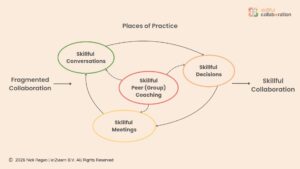
Using the Cynefin model is one of the fundamental building blocks of skillful decision-making in teams. And skillful decisions are at the heart of skillful collaboration.
If you’d like to explore more of these building blocks… let’s collaborate!