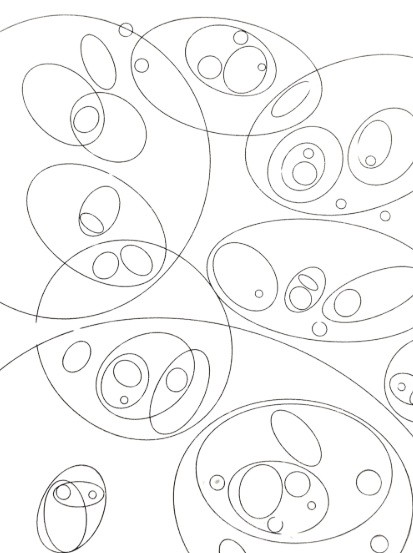
I recently came across the term holon, created by Arthur Koestler. It describes something that is simultaneously a whole and a part.
I love the artwork of the holon image (from Collaboration with the Enemy by Adam Kahane, illustrated by Jeff Barnum). To me it feels dynamic and complex — a perfect metaphor for individuals and teams, especially when they are in meetings.
In teamwork, it looks like this: a team member is a whole person, and at the same time a part of the team — which is also whole. The team itself is whole, yet part of a larger organization. I love this concept because it shifts us away from individual OR team toward individual AND team.
The individual bias
In Western society, we lean heavily toward the individual. Our education focuses on personal exams and grades. Careers are measured by individual performance goals and promotions. We admire powerful or inspirational leaders — individuals — for their vision and motivation. Even when celebrating great teams, attention often goes to the star player.
I’ve sat in many meetings with such star players and powerful leaders. Very often, they weren’t great (or skillful) meetings. Air time was consumed by a few individuals. When others spoke up with ideas or questions, their input was often ignored. Many of these meetings became long monologues, or circled back to the leader to make the decision.
What better meetings look like
I prefer meetings with a roughly equal share of voice. Research from MIT’s Alex Pentland shows this leads to better decisions, higher morale, and stronger performance. It also builds confidence for quieter members.
I also prefer meetings with just a few prioritized agenda points — ideally focused on decisions the team must make. Each point needs a time frame, clarity on who the decision-maker is, and the right people in the room to actually decide.
Equally important is choosing the right mode of talk. Too often, meetings drift into endless conversation or get stuck in arguments between two people locked in their own perspectives. A skillful debate — where more members join in, even switching sides to understand other positions — can be far more valuable. Sadly, I don’t see real debate often; it has been replaced by “arguing,” “influencing,” or one of my least favourite terms… “healthy conflict.”
Meetings as holons
Perhaps meetings themselves can be seen as holons: each agenda point is a whole and also part of a meeting; each meeting is a whole and also part of a series of meetings in an organization.
I love how the holon image flows dynamically between the wholes and the parts. It’s a powerful metaphor for how decisions could flow in meetings and across meetings in organizations.
When we remember this, we honor both the agenda point and the meeting — enabling us to grow both the individual and the team.
How does your team skillfully collaborate in meetings?
And how could this enable both your team members and your team to grow?