
Over 20 years ago, I was promoted to Engineering Manager. With this career move, I gained more responsibility — for more people in my team, more customers, and new peers in the cross-functional organization.
In our corporate hierarchies, when we gain more responsibility, we also gain more power.
I gained more power in terms of deciding the technical direction of the products we were developing and supporting my team in their professional development.
I gained more power with customers, who consciously or unconsciously understood that an Engineering Manager has more clout (power, influence, credibility) than an Engineer — and treated me accordingly.
I gained more power with my new peers in the organization because they also understood the “rules” of a hierarchy.
Only, wait a minute — this wasn’t as simple as I describe above. Power games are not this simple in our complex organizations.
The technology we were developing was new and innovative, the customer was new and from a different culture, and my peers had different perspectives and ideas — and were not all at my level in the organization.
With the engineering team, I couldn’t simply make all the technical decisions because I wanted to empower my engineers and also consider input from my boss, the Engineering Director.
With the customers, they connected with me when sometimes it would have been better for them to connect directly with my team of engineers.
With my cross-functional peers, they were responsible for project timing, cost, and quality, so my engineering power (bias) sometimes clashed with their other priorities.
In one particular meeting with one of my new peers, the competing priorities and power games exploded into a full-on 30-minute conflict. I had my way of leading and managing, and he had his — and they were seemingly at opposite ends of the management and leadership spectrum. In the organizational hierarchy, he was at a more powerful position than I was, a Senior Director, and he asserted quite clearly (and, I felt, angrily) that even though I was technically responsible, in fact he had all the power for decisions in the project team.
This meeting was only 30 minutes long but felt like a lifetime. I didn’t like conflict. I can still feel the disbelief — and some amount of fear — in how my new peer was asserting his power.
Afterwards, I had a chat with my boss. I was seriously thinking that this wasn’t going to work out. My boss calmed me down and asked me to give “the relationship and the project” some time. Later, I also had a chat with my father, who gave me similar advice — which I took.
Eventually, over time, I learned to work together with my team, the customers, and my new peers — but it took time, and it took some painful power game lessons. I lived through a change — my promotion — and also a change in the context of an organizational system that was itself changing. Change and adaptation create tension, which can lead to power games, struggles, and conflict.
Eventually, over time, the “troublesome” peer became a respected colleague, and together with our teams and the customer, we delivered a really tough project.
Looking back now, I’ve learned a lot through experience and learning about the world of teams. Power in teams and in systems is real, and it can be felt both in task and in relationships. It often shows up in the assertions of others or in their advocating — sometimes demanding a position.
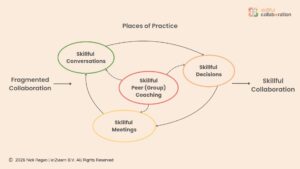
If I take a Skillful Collaboration perspective on Power, I would name three areas to consider:
- Have a conversation about who has the authority to decide. Make this explicit.
- When approaching decisions, teams often take a “power over” approach — how can we use a “power with” approach instead?
- If you’re aware that somebody is strongly advocating a position, get curious about their idea or position rather than immediately advocating your own.
If you have other areas to consider about Power Games, I’d love to hear them.