How many conversations have you had like this?
Person A: “I think we should do X, and here are ten thousand reasons (that I’m right).”
Person B: “Oh, I think we should do Y, and here are ten thousand reasons (that I’m right).”
Person A: “Okay, but I still think we should do X, and here are the same ten thousand reasons (that I’m right).”
Person B: “Okay, but I still think we should do Y, and here are the same ten thousand reasons (that I’m right).”
Person A: “Let me try to explain why we should do X — and here are once again the same ten thousand reasons (that I’m right).”
Person B: “Hmm, let me try to explain why we should do Y — and here are once again the same ten thousand reasons (that I’m right).”
Advocating, advocating, advocating.
On repeat. On repeat. On repeat. On repeat.
During my career, I’ve experienced this so many times… in so many meetings.
Between C-suite leaders. Between Function Director A and Function Director B.
Between function leader and team leader. Between team leader and team member.
Between engineering and validation. Between project management and engineering.
Between sales and marketing.
Do you recognize it too?
These kinds of conversations are so frustrating, so disengaging — and such a waste of time and energy.
David Kantor, in Reading the Room (2012), called this a repetitive pattern. Other practitioners call it a stuck pattern.
Maybe this isn’t the time to have a conversation about which is the right term… 😊
These team conversational dynamics are so common in our workdays (and in our personal lives) because humans like to be right — and most of us were educated to advocate rather than inquire.
But inquiry is the way out of these repetitive patterns.
Inquiry allows us to practice curiosity about the other person’s opinions and ideas.
It encourages perspective-taking (a leadership superpower), generates empathy and learning, and can inspire creativity to discover an even better option than X or Y.
And maybe even more important than all of that — it enables a resonant human connection of feeling heard.
If you’d like to build the conversational skills that enable this shift — from a negative advocating spiral to a genuine connection of feeling heard —
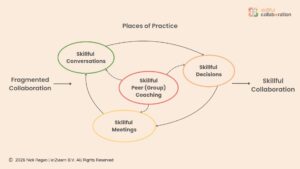
Let’s learn about having Skillful Conversations, a fundamental building block for Skillful Collaboration.
Interested to know more?
Let’s connect!