When I hear terms such as Healthy Conflict, Fierce Conversations, or Atomic Habits, I feel myself close down. My body literally contracts. Maybe it’s my natural / learnt freeze response to words like conflict, fierce, or atomic. Or maybe it’s simply fatigue from the war-like noise in our world and the constant competing polarities we navigate every day.
When I’m in conflict or in an argument with someone, I quickly move out of freeze and often straight into attack mode, reinforcing my position. Which, funnily enough, is also a military term — something I only realize now as I type.
And with all these competing polarities, whether I like it or not, people on both sides tend to place me in the “for” or “against” camp.
It’s really tiring: managing my emotional response, deciding my position, and then being placed somewhere by others anyway. The body, the head, and the gut are all affected. Of course it’s exhausting.
A couple of years ago, I completed a brilliant training program at the Academy of Professional Dialogue, which gave me lots of new insights — and lots of energy. 😊
One of my favourite learnings from that program, and something I come back to often at work and at home, is the absolute awesomeness of debating.
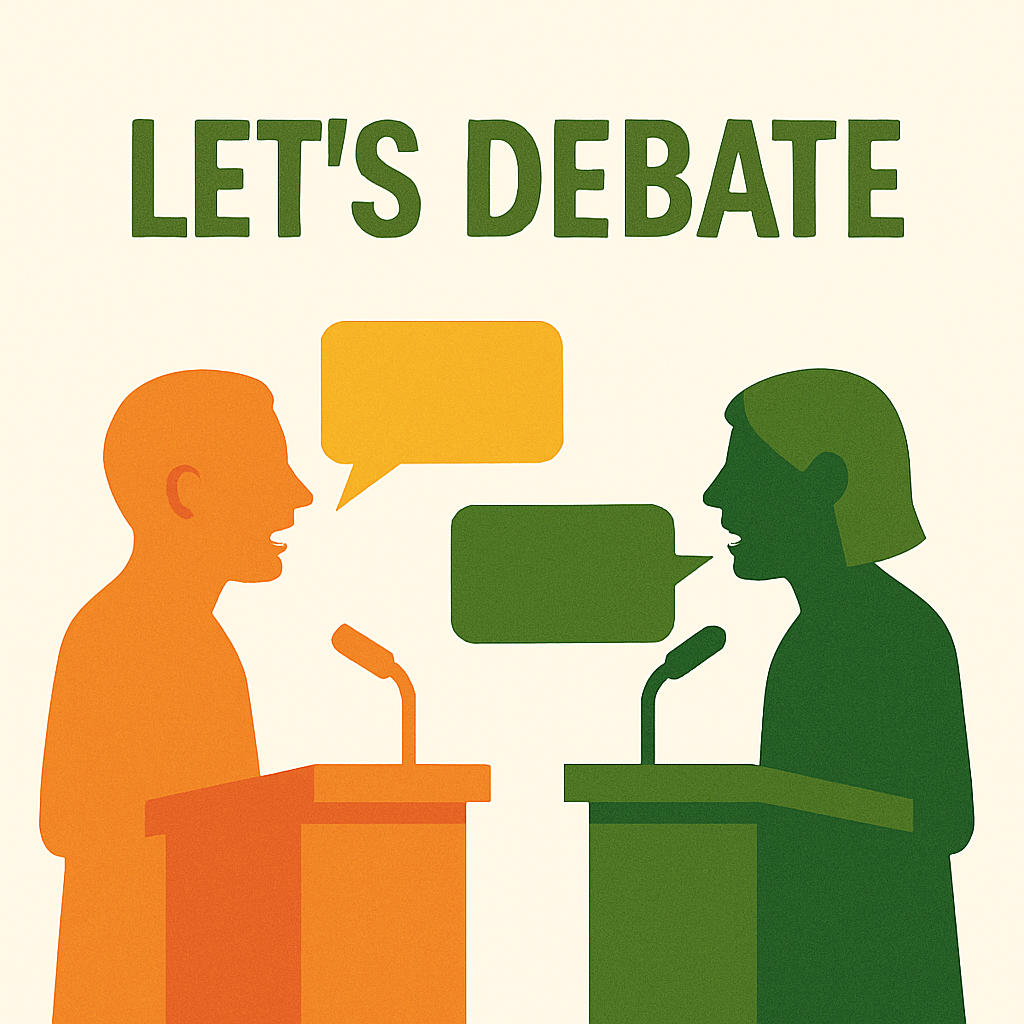
During the program we held several debates, and between sessions I brought this “Let’s Debate” activity to my clients.
“Debate” comes from the Old French word debatre, meaning to beat down.
And that, in turn, comes from the Latin root battuere — to beat or strike.
Hmm… so we’re seemingly back to attacking each other… closing up…
BUT actually, debating is fabulously valuable — because we don’t set it up as a “fight,” but as an event where two or more people present opposing arguments on a particular topic. It involves reasoning, evidence, and structured exchange — not just fighting, but considered disagreement.
Setting the theme of the debate is also a wonderful task. Choose something that gets the blood flowing, for example:
- “Female leaders are more effective than male leaders,” or
- “Supplier A will be a better partner than Supplier C.”
Depending on your organisational context, pick something that matters to the people who are debating.
It also helps to set the theme as a motion, e.g.:
“This house believes that customer niche X is a better space for us to target than customer niche Y.”
Then let each side state their arguments — for and against the motion. It’s fun to see how the arguments build and how understanding on both sides grows.
And THEN… here’s the part I love the most.
Have both sides swap positions.
YES. Have them switch sides.
This is where the magic happens: each side builds on the other’s arguments and can truly empathise and see from the other perspective.
Soon enough, new ideas emerge, and both sides feel heard and understood. Then you can shift away from the debate and move into some kind of decision or action — or maybe not. Maybe you simply end with a richer understanding of yourself and others on a motion such as:
“This house believes that female leaders are more effective than male leaders.”
So yes… this house believes that we can do better than terms like Healthy Conflict, Fierce Conversations, and Atomic Habits.
In the comments…
Let’s debate!