What is your stance when you’re coaching your team?
An important competence of being a leader, and of leading a team, is the competence of coaching.
According to the International Coaching Federation (ICF), coaching is:
“partnering with clients in a thought-provoking and creative process that inspires them to maximize their personal and professional potential.”
If we bring this definition into the context of leadership, then the ‘client’ becomes the ‘team member’, and the value of coaching becomes clear.
Moving from the individual to the team, ICF describes team coaching (through its Team Coaching Competencies) as:
A reflective, co-creative process with a team that focuses on the team’s dynamics, relationships, shared purpose, and collective goals — fostering high performance and ongoing development as a collective system.
Again, when reading this, it becomes clear that coaching one’s team is a very important aspect of leadership.
I believe that developing coaching and team coaching competencies can be a real superpower for leaders.
However, I also believe that coaching and team coaching are NOT exclusive skills for leaders.
Great value can be created when each and every team member learns and practices these skills. After all, team members work together with each other and with their leader — so why wouldn’t they be interested in partnering with each other in a thought-provoking and creative process, and in fostering high performance and ongoing development?
I truly believe that when teams and their leaders learn together the skills of peer coaching and peer group coaching, this opens up powerful potential for improving team performance, productivity, and engagement.
But where to start with this learning?
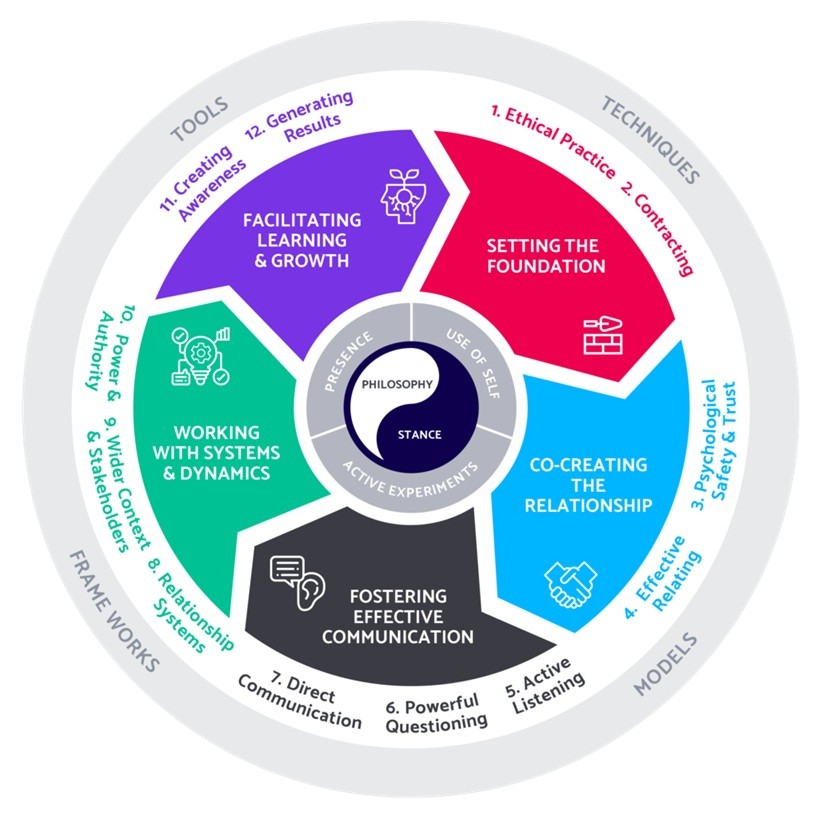
I am very drawn to the Team Coaching Competency Framework developed by Georgina Woudstra, which is aligned with the ICF Team Coaching Competencies. A few years ago, I learned and practiced the skills of this model with Georgina and Allard at the Team Coaching Studio, and it became an important part of my own development as a team coach.
I would love for others to learn ALL these competencies too. But that’s probably a few steps too far…
So what might be a step to better…
For this step (and this post), I want to guide you to the centre of the model — the yin and yang of it. The core of the model, and in many ways the core of team coaching… and 1:1 coaching … and, I believe, also the core of peer coaching and peer group coaching. It comes down to two key questions:
What is my philosophy? (What do I truly believe?)
What is my stance? (What will I stand up for?)
I believe that when teams and their leaders reflect on and have conversations about their own and each other’s philosophies (beliefs) and stances, this becomes a powerful first step towards learning the skills of peer coaching and peer group coaching.
Here is one of my own examples:
What is my philosophy?
I believe in learning.
What is my stance?
I support and challenge teams and their leaders to slow down and reflect, because this creates opportunities for learning, growth… and improved performance.
My question to you is this:
Can you imagine the impact on your team if you started having conversations about what you truly believe in (your philosophy) and what you are truly willing to stand for (your stance)?
If yes, let’s connect.
I’d love to explore this with you.
p.s. Here is the reference for Georgina’s book on Team Coaching.
Ref : Woudstra, G. (2021). Mastering the art of team coaching: A comprehensive guide to unleashing collective intelligence. Routledge.