Team of Teams Event – Growing the Human Skills of Collaboration Through Practice
A couple of months ago I was invited to give an inspirational speech about Skillful Collaboration. The speech was to be part of a team event for an IT group of 50 people with the overall theme of “Partnering and Connecting with the Business.” I was happy to give a “speech,” but when I met with the organising team I also offered to make my session more interactive, with learning activities rather than a one-way monologue. I also proposed helping to co-design and facilitate the whole day while I was there. The organising team felt this was a good suggestion and said yes!
The context of the “team” is that they actually consist of six IT teams supporting the business in the Benelux, one team focused on supporting European sales, and one team with a global focus. So eight teams plus a management team guiding them — nine teams in total. This is a relatively new structure, and the event was the first time all 50 people had been together.
The morning session focused on the teams getting to know each other, and more specifically what each of the different teams actually does. We invited the teams to work on the question: “What would we like to be famous for?” and gave them a simple template to tell the story of What, How and Why they would become famous. The teams dived in and were also tasked with creating a supporting image — being IT teams, several of them used Copilot for their visuals rather than the colourful pens and flipcharts we had provided.
The morning was wrapped up with a series of fun 2 minute elevator pitches about each teams ‘Aim for fame!’
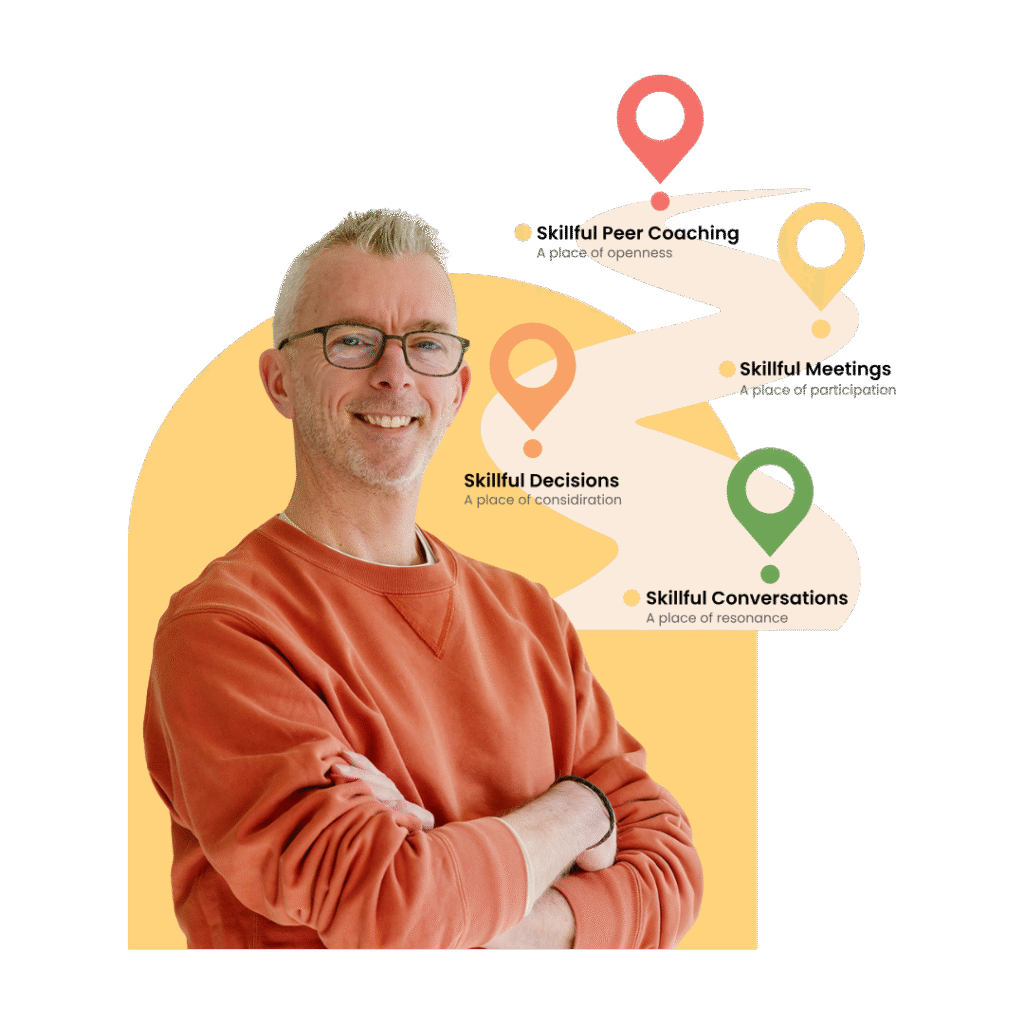
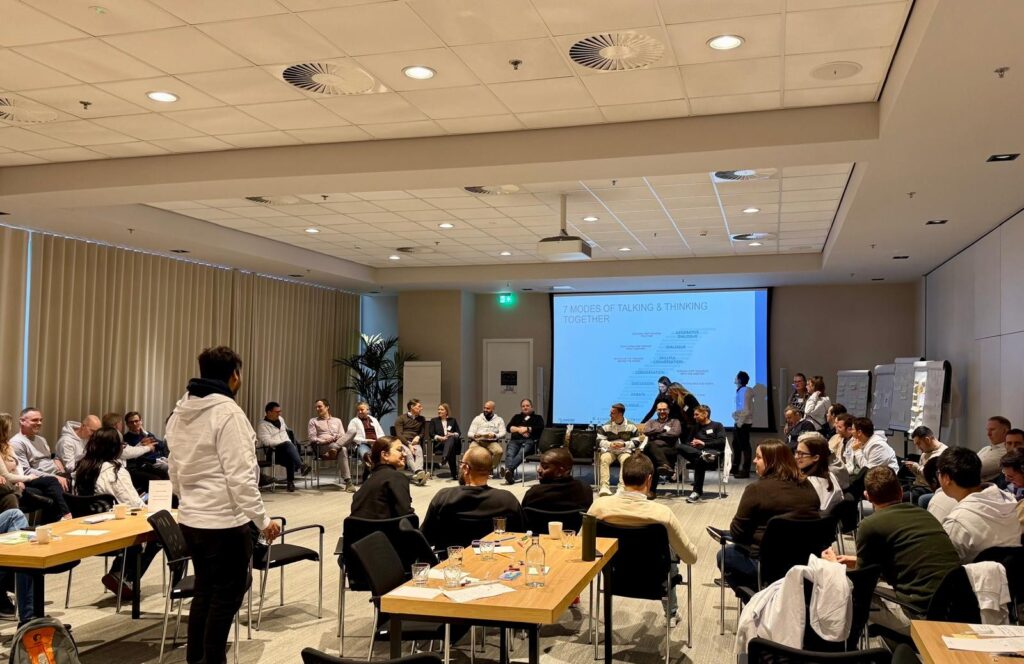
In the afternoon I introduced the concept of Skillful Collaboration and focused the interaction on Skillful Conversations, which is one of the 7 Modes of Talking and Thinking Together. Then we moved into the fun of practising some of the modes.
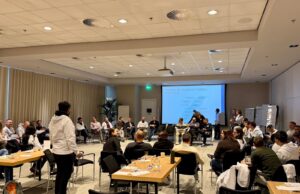
The room was initially set in a theatre style as I was presenting, monologuing and answering questions. During the morning session the teams had already experienced monologue through their elevator pitches, so I asked how monologue shows up in their team meetings. The response was immediate: “Often!”
Practising Debate
Next we moved into debate. We rearranged the chairs into a parliament style with two sides facing each other and four chairs placed in the middle for the debaters. I asked for volunteers and four brave people stepped forward. We chose a topic — Global vs Local Decision Making — and the motion became:
“This house believes that all decisions should be made locally.”
The debate began. The motion side laid out strong arguments: closeness to customer needs, cultural context, agility, and P&L responsibility. The opposition countered with the need for standardisation, scalability, global opportunity, and unity as one organisation — while smiling and laughing along the way 😊
The two sides of the debate were serious, but the room was smiling as this familiar “corridor argument” played out in front of everyone. Frustrations turned into lightness.
Midway through, I asked the four debaters to switch seats. They looked quizzically at me but did it. Then I asked those who had just opposed the motion to now argue for it. One of them laughed and said, “I need a few seconds so my head can catch up with where my body is now.” After a pause, they continued — now advocating the opposite view with equal conviction.
When the debate ended, both sides were applauded and we agreed that both had ‘won.’
Isn’t it a powerful skill of partnering to literally put yourself in someone else’s shoes — or in this case, someone else’s chair?
The origin of the word debate comes from the Latin battuere — “to beat” or “to strike.”
So we could say a debate is to beat down the opposition. If we stay fixed in our positions, we become entrenched. Our egos certainly find it uncomfortable to lose.
The learning here was simple: How can we truly step into another perspective?
The teams reflected on how they might bring this into business conversations — and even practise by debating with themselves in advance.
Let’s Discuss
The room was full of energy from the debate, so next we focused on the mode of Discussion.
I added an extra chair to the four chairs in the middle and asked for five new volunteers. Up stepped the next five courageous team members and I gave each of them a post-it and a pen. I announced that they were going to have a “discussion” and invited them to write the first three words that popped into their heads on the post-it. I reassured them it could literally be anything.
After a few seconds they all had their three words. I asked for a timekeeper to set a three-minute timer and challenged the five volunteers to have a discussion where each of them had to mention all three of their words at any point during those three minutes.
And off they went…
“Wasn’t the FOOD really great at lunchtime?”
“Yes — and I’m really enjoying being here in the Dutch city of UTRECHT.”
“Ah yes, I went for a lunchtime walk in my new SHOES.”
“I like going for walks with my FAMILY.”
“Oh you have a family — my SON is getting married this weekend!”
And on it went — three minutes of random yet familiar interaction.
The room was smiling and laughing at how recognisable this felt. We see and hear these interactions so often: around the coffee machine, outside meeting rooms, during lunch breaks. This is small talk — easy, relaxed, and low-effort. It has real value, especially for decompressing after a stressful moment.
However, in a team meeting, if an agenda point becomes a random stream of statements, it may be useful for brainstorming, but it rarely leads to collective decision-making.
Experiencing Conversation
Before moving into Skillful Conversation, I first wanted the teams to experience a Conversation.
I asked the people in the room to arrange their chairs into groups of three and to try to find people they didn’t usually work with. There was lots of energy as chairs shuffled and people moved around. After a couple of minutes, the triads were formed and I set them off with a simple instruction:
“You have five minutes to find something unusual that you have in common.”
The noise surged — laughter, rising voices, moments of silence, and then more laughter as discoveries were made.
After five minutes I called time and invited a few groups to share:
“We all had hamsters when we were small.”
“We all enjoy cycling… and none of us are Dutch!”
“We all play a team sport.”
“We’ve all travelled to Thailand.”
Then I asked about the experience, not the content.
Many groups shared that they enjoyed it, that they felt closer to their colleagues, and that it was fun.
We then explored the difference between the Discussion exercise and the Conversation.
In Discussion, we mainly advocate — we bring statements or topics forward.
In Conversation, we still share, but we also inquire, listen with curiosity, and sometimes learn something new.
The value of Conversation is connection — feeling heard and feeling closer.
Skillful Conversation – Dialogic Actions in Motion
Then we moved into Skillful Conversation, which essentially means having the ability to converse well and intentionally.
I created a large circle of chairs and placed four flip-chart sheets on the floor labelled MOVE / FOLLOW / OPPOSE / BYSTAND. As I walked around the circle, I explained:
- Move: making a proposal or sharing an idea.
- Follow: agreeing or supporting a proposal.
- Oppose: disagreeing or blocking a direction.
- Bystand: adding information, summarising, or asking clarifying questions.
I also explained that we often use compound plays — for example, proposing something and then adding several reasons, which blends Move and Bystand.
I then invited one team to the centre to decide together:
“What will be the best location for the next team event?”
Four people stepped in. The team leader ‘naturally’ spoke first, walked to MOVE, and said:
“I think we’re fine here in Utrecht — let’s have the next event here too.”
After a pause, another team member stayed in the middle and said:
“Maybe we can try somewhere else… how about The Hague?”
I asked, “Are you saying No to Utrecht?”
He nodded, and I guided him to OPPOSE where he said “No,” then over to MOVE to make his proposal.
Moments later another participant stepped forward:
“No! Let’s go to Barcelona — several of us are from there, it’s a great city!”
I guided him to BYSTAND to add his reasons. The group visibly warmed to the idea. I then asked:
“If you agree, move to FOLLOW and say YES.”
And one by one they moved over and said “YES!”
The room applauded as they returned to their seats.
We then reflected using the Process / People / Content lens.
We noticed quick proposals, little inquiry, fast convergence, and polite agreement. It was playful, but the patterns were familiar.
The core learning emerged clearly:
We don’t lack ideas.
We often add information to further advocate ideas.
We are uncomfortable saying No!
We don’t always voice our YES!
And maybe above all we often lack skills of intentionally using of the ‘actions’.
Applying the Learning
After the fun activity of choosing the city for the next team event, the teams worked in seven cross-team sub-groups to make a real business decision together.
Each sub-team evaluated the recent Employee Engagement survey and agreed on one topic to improve this year — practising real Skillful Conversations.
For 45 minutes I observed increased curiosity, more respectful opposing, clearer proposals, and intentional agreement. Each group reached alignment and made their proposal.
NOTE: The following morning the full team narrowed the seven proposals down to two shared priorities for improving team engagement.
Closing Reflection
At the end of the day we reflected on what the team(s) had learnt and practised. They had shifted from habitual conversations in the morning to more intentional and skillful ones in the afternoon.
My closing invitation was simple: skills are built through practice. The aim of the day had been connecting and partnering, and the only way to become skillful at this is to consciously practise the different modes of talking and thinking together —
not just in workshops, but in everyday interactions, including meetings.
And then something unexpected happened. Everyone in the team was presented with team hoodies and they handed me one too. Afterwards I was invited into the end of the day ‘team selfie’ celebration. That was a great feeling! At the start of the
day I had arrived as an external partner. By the end of the day, through practicing how we talk, listen and think together, I felt genuinely welcomed inside the team.
That is the real power of skillful collaboration — it doesn’t just change conversations, it creates human connection and a real sense of partnering