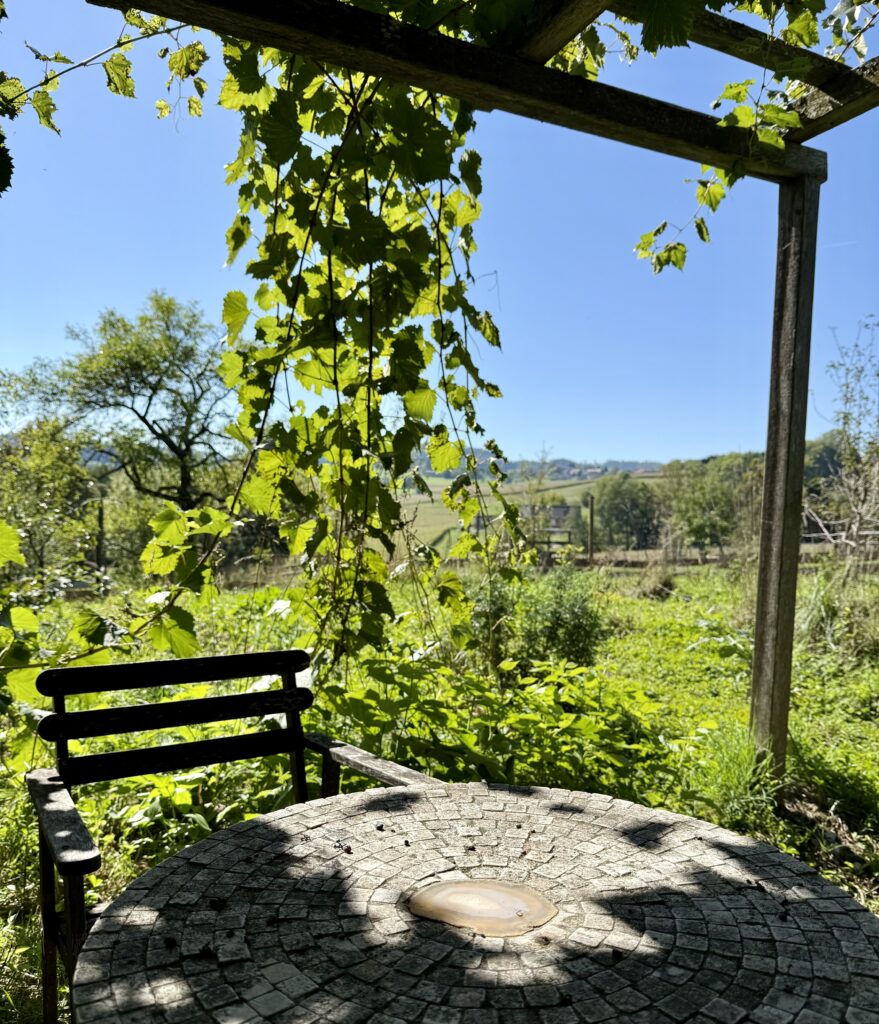
I just spent a few days visiting friends who live in a group of farmhouses in the beautiful rolling hills of Styria (Steiermark), Austria. It’s an amazingly calm place, surrounded by wheat fields, meadows, vineyards, and forests. The noise of farm animals and tractors occasionally drifts across the hills. Otherwise, you hear birds, insects, and the breeze passing through the trees.
One of my friends moved there 14 years ago from Brussels, where he had worked for the European Commission. The other moved there last year from Berlin, soon after they met — and now they are happily married. They both work as coaches and consultants, doing most of their work online.
They live there in community with several others: a young man in his twenties, a woman with her two young boys, and a couple who were moving in as we were leaving. Some live there permanently, others visit and pass through. Sometimes farm workers call by to help with the sheep or with construction.
Living in community, side by side
They live together in community, but also side by side.
The community part is that each person does something each day for the whole — mowing the lawn, chopping logs, cleaning the houses. Sometimes they eat together, and always (at least during our visit) they look out for one another, taking a few minutes to talk, listen, wave, or smile in passing.
The side-by-side part is that they go about their lives independently — with their own work, their own spaces in the farmhouses, and their own kitchens.
The way they live appears so simple and idyllic. Of course there are tasks that need doing, and they share them. And there are sometimes tensions, but they always seemed to talk them through with respect. The kids were even invited into those conversations. One neighboring farmer has been “angry” with these city dwellers ever since they arrived — and yet they continue to try to empathize and connect with him.
Closer than it seems
This quiet and calm place feels like quite a contrast to the world I read about in the news — and to what I experience in many organizations and in everyday life.
And yet, I don’t think the contrast is so very big.
I also experience community on the small Dutch street where we live. It’s certainly noisier than the Austrian hills, but with our neighbors we often help each other out whenever there’s a need. We talk things through and listen respectfully if tensions arise. We welcome visitors with a smile or a hello. And if we have any “angry” neighbors, we try to connect with them rather than antagonize.
I also experience community in teams who pull together to get things done. In organizations that want to contribute not only to their P&L, but also to society and the planet. And in good people who are willing to enter compassionate conversations about the awful things we read in the news.
One conversation at a time
I returned home with the feeling that it is possible to live in community. In fact, most of us already do this — quite successfully.
We do it in our homes and neighborhoods.
We do it in our teams and organizations.
Of course, there will always be some “angry” neighbors. That’s part of reality.
The real question is how we choose to engage with them.
Being together in community starts with one thing: talking and respectfully listening — one Skillful Conversation at a time.