I recently came across a few annual reports from the field of Learning & Development. It’s that time of year again.
The focus of these reports over the last few years has been the emergence of AI and this sits near the top of the priorities, alongside the complimentary themes of re-skilling, upskilling, and skills-based organizations.
But even more important according to these list is the ever-important, top-of-the-pile topic of Leadership & Executive Development.
Which prompts the question:
How will L&D support our leaders and executives to deliver business results while learning and leveraging AI and upskilling / re-skilling their workforces?
It’s complex. It’s a race. We need to get there fast. It’s already the end of February and we’ve got so much to organize. Let’s go!!
But… rather… let’s not go so fast.
I have a different question, because it’s actually teams (together with their leaders) that will learn, develop the skills needed, and deliver the business results.
So where, oh where, is Team Development on these lists and reports of Top Priorities for L&D?
We talk about many types, forms, and styles of Leadership Development, and we talk often about Organizational Transformation. And yes — developing leaders and transforming organizations are hugely important. But once again, it’s the teams that ‘do the work’ so where in these reports is the call for Team Development and Team Transformation?
I have a hypothesis… if I may:
1. Our world is overly focused on the individual. Our education systems, career development, performance & reward systems, talent management — not to mention our geopolitical and social-media world — all shine a light on and reward the individual. Individual needs become expectations, and this becomes the focus of L&D.
2. The world of Team Development is over 20 years behind the world of Leadership Development — at least if we take a snapshot from the field of Coaching, which (happily) does appear on these lists. The ICF individual coaching competencies were first released in 1998, while the ICF Team Coaching competencies were released in 2020/21.
So sorry about this, teams of the world — if my hypothesis is even partly right, it’s going to take some time and effort to get you onto these lists…
We need to shift from a paradigm of “me to we.”
And we need to learn about developing teams.
I do love a challenge, so let’s get started… with learning about developing teams! It’s a small but important step.
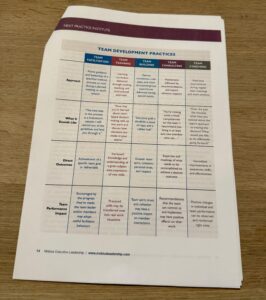
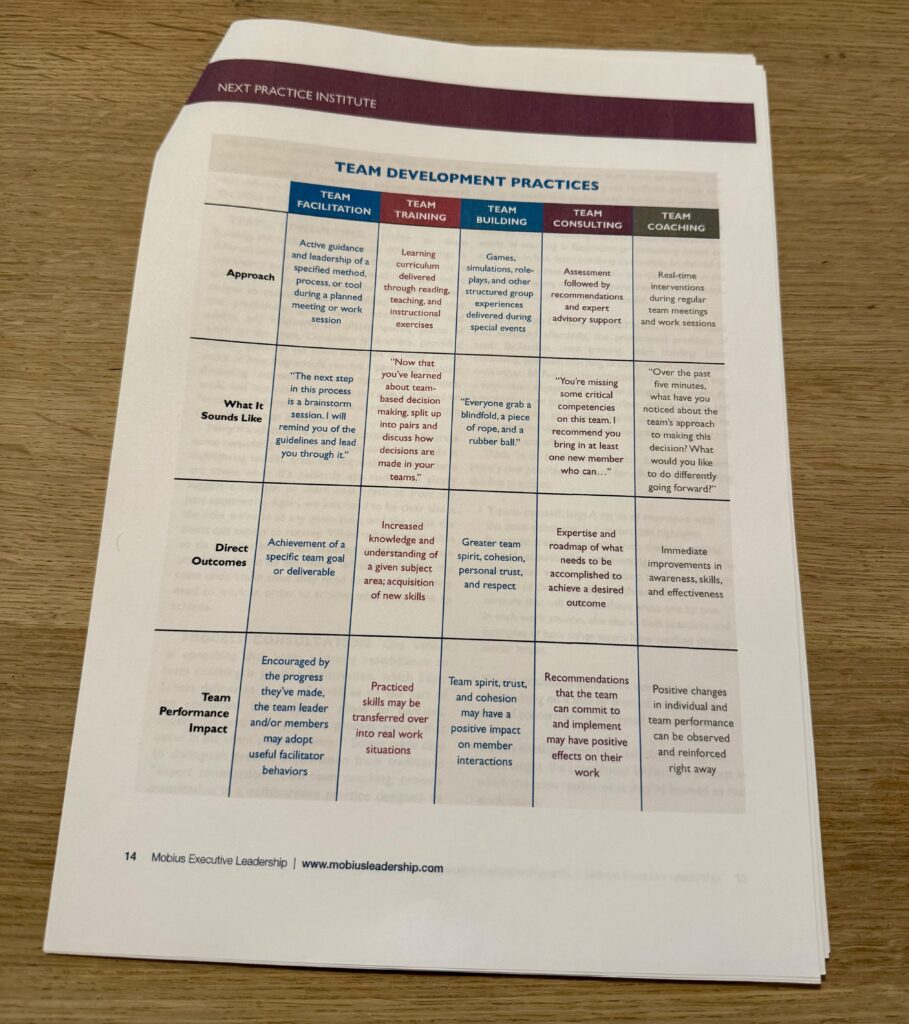
Firstly — take a look at these different types of Team Development practices. (See the image.)
They all have great value, but if you only know one or two of them, it’s probably worth exploring the others.
Here’s the value of each:
Team Facilitation — Helps a team make decisions and run meetings and work sessions more smoothly so they can reach specific deliverables efficiently.
Team Training — Builds new knowledge and develops practical skills that team members can later apply in their real work.
Team Building — Strengthens trust, cohesion, and personal connection, improving the emotional climate of the team.
Team Consulting — Provides expert assessment and clear recommendations so the team knows what to change and how to move forward.
Team Coaching — Creates real-time awareness and behaviour change during actual work, leading to immediate and sustainable performance improvement.
And not forgetting:
Team Mediation — Provides a structured, neutral space for surfacing and resolving interpersonal or systemic conflicts so the team can restore trust, clear tension, and move forward productively.
If you’ve got this far, you’ll probably get that I believe in the power of teams. I also believe that leaning into Team development is also a step from ‘me to we’.
If you share these beliefs and would like to explore how you can develop teams in your organisation —let’s connect.