“No. I’m not doing that!”
That was the unexpected response I received from a team member while facilitating a strategy session. I had suggested that one person present the team’s strategy while the others role-played key stakeholders.
I’ve used this activity many times. It’s a powerful way to empathize with stakeholders and test ideas before presenting them for real. So I explained it again, only to hear once more:
“No. I’m not doing that! That’s a complete waste of time.”
“Ok,” I replied.. after a few seconds of (stunned) silence, receiving a ”No” can be an experience,,,
“What do others suggest?”
The team quickly offered empathy for their colleague and an alternative: rather than role-play, they imagined and collected the types of feedback stakeholders might give. The colleague gladly joined in and it worked beautifully. Everyone had input. And I was reminded of the power of “No.” Sometimes, it’s exactly what sparks new thinking and new ideas.
Why “No” is so hard
Saying ”No” isn’t easy.
Evolution has conditioned us to say ”Yes” so that we’re not excluded from the group. Our childhood experiences often reinforced the same pattern — especially in response to authority. Many women, in particular, are still burdened with outdated expectations to always be agreeable, caring, accommodating and hence feel the burden of constantly saying “Yes”.
But always saying “Yes” comes at a cost: exhaustion and frustration. In extreme cases it can eventually lead to burnout.
What I learned from Adam Grant
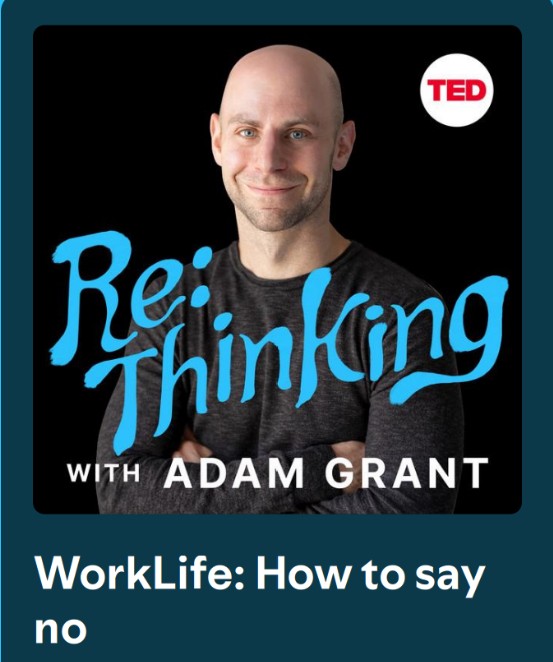
In one of my favourite podcasts, Adam Grant dives into the science of ‘How to say No’. Three takeaways stuck with me:
- Have a policy. For example, Grant never writes forewords for other books — it’s his standing “no.”
- Remember that yes isn’t always a strength. Saying yes too often leads to depletion, not contribution.
- Practice playful no’s. One of my favourites: “Sorry, I can’t do that… for secret reasons.”
Why teams need “No”
If no one says ”No” in your team, you may be stuck in groupthink — or lacking psychological safety. Skillful conversations require someone to ‘disagree’. They need the courage of “No” to unlock creativity and bring rigour to the conversation.
So here’s a simple experiment: at your next team meeting, just try saying “No”. See what new ideas it sparks.