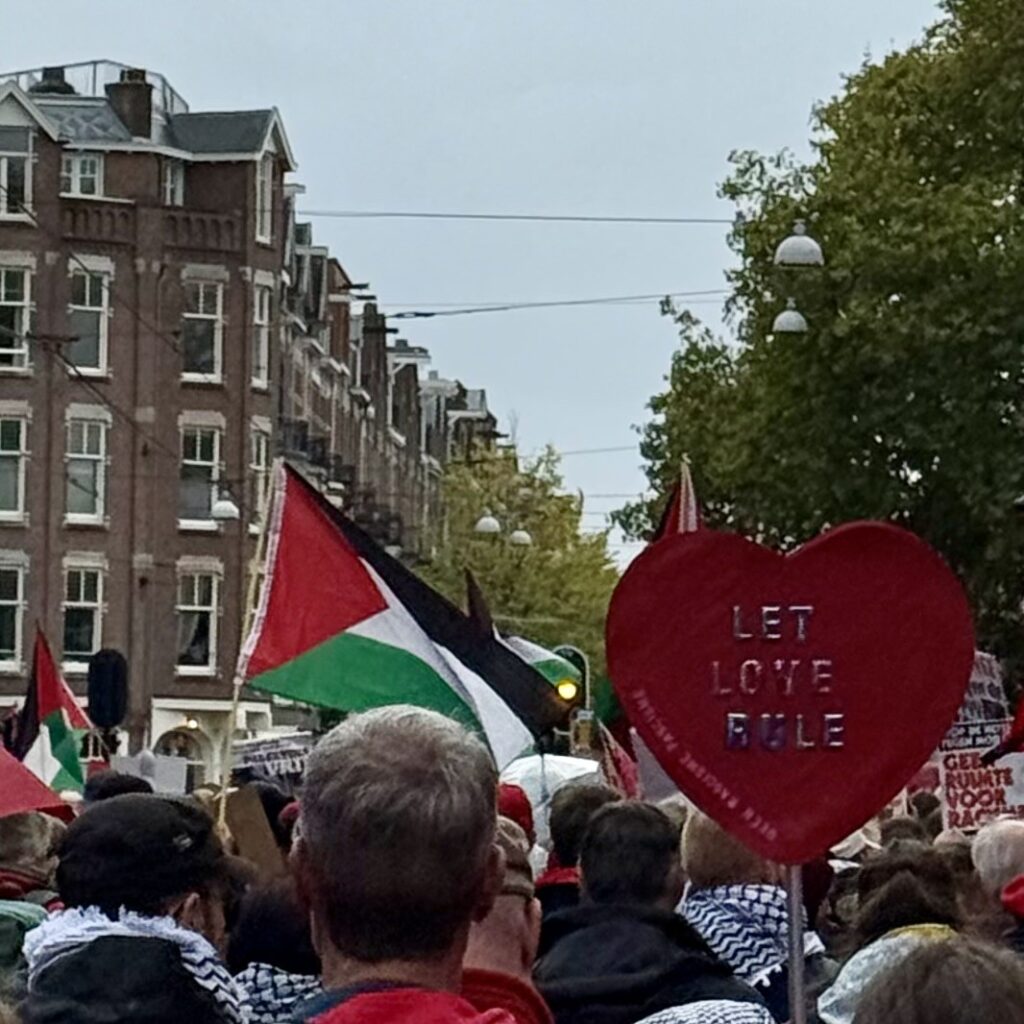
Yesterday I was one of 250,000 people who marched in Amsterdam in a demonstration for peace and against the genocide taking place in Gaza.
It’s only the second time in my life that I’ve felt the urge to join a demonstration. The first was earlier this year when I joined 150,000 people who marched for the same reason in The Hague.
Several months have passed since we walked in The Hague, and many thousands more people have been killed in Gaza.
As I set off to Amsterdam with my neighbour, we talked with some hope that finally there may be a breakthrough between Israel and Hamas, with a statement released by Hamas saying that they agree to release all the Israeli hostages in the coming days.
We hope that there is finally some hope.
And yet, this hope can so quickly disappear in the power struggle between these two decades-long enemies.
I recently read a fascinating book called Collaborating with the Enemy by Adam Kahane. He’s worked for over 30 years in the field, facilitating seemingly hopeless international and national conflicts.
In these situations, he has come to realize that collaboration is not the only option.
He’s experienced four:
- Adapt: we can’t change the situation, we will ‘simply’ get on with taking care of ourselves.
- Leave: we can’t change the situation, we will leave this place.
- Force: we believe we can change the situation by imposing our top-down solution.
- Collaborate: we believe we can change the situation by working together at many levels.
Of course, over the decades in the Israeli–Palestinian conflict, we have witnessed many of the first three choices and little of the collaboration choice.
And yet, if we look back on history and we (humans) want to survive — and eventually thrive — collaboration remains, in the end, the only choice.
Another brilliant part of Kahane’s work focuses on the polarities of Power and Love, where he borrows the definitions of Paul Tillich:
- Power: the drive of everything to realize itself.
- Love: the drive toward the unity of the separated.
He explains the benefits of both asserting (power) and engaging (love), and uses the metaphor of breathing to show how both can be dynamically used — the inhale, the pause, the exhale, the pause, on repeat.
Similar to breathing, we can’t survive by only inhaling or only exhaling. We can’t survive by constantly asserting power.
On the march, I was particularly drawn to the banners that people carried. Some banners I didn’t agree with — of course, it’s not possible to agree with everybody on everything in a group of 250,000 people.
But we can agree about what matters to all the individuals: that the genocide must stop and that peace is the only way forwards.
And here is a small placard that did resonate with me…
It’s time to take a pause from the power cycle — and give some time and space to Let Love Rule.