Context, Source, Message, Recipient:
“I think it’s better if you look for another job.”
This was the ‘feedback’ I received from my first boss, 18 months after I had landed my dream job, age 22, as a Product Design Consultant.
This feedback really hurt my ego. Since the start of high school, I’d dreamt of becoming a Product Design consultant. I’d chosen design-focused subjects in my B.Eng and Masters. I was so excited when I landed the job — I loved ‘design.’
After the hurt, came a feeling of shame arrived. I’d never really ‘failed’ at anything in my life until then. How would I live with this failure? How would I explain it to others? If a hole had opened up beneath me, I might have chosen to fall into it.
But deep down, I knew there was truth (and logic) in what my boss said. In fact, I actually agreed with him.
He was / is a good guy. He’d recruited me straight from university, given me interesting projects, excellent senior colleagues to learn from, even the lead on a new part of the business in Rapid Prototyping. But somehow the company and I weren’t meant to be. It was a small business focused only on the concept and development phase of the product lifecycle. Teams of consultants worked mostly independently. There wasn’t space — or budget — for me to really develop my engineering skills. At that point in my career, it simply wasn’t a good fit.
So, I swallowed the feedback and my wounded pride, and quickly found a new job in Automotive Engineering. There, I worked in bigger teams with cross-functional colleagues. I was like a fish in water. I could learn, develop, and contribute in a way that made me flourish.
Looking back, that painful feedback turned out to be a real gift. There was some short-term hurt but it lead to long-term growth.
Emotions & Relationship
Feedback moments are emotional events. For them to be “good,” both giver and receiver need emotional maturity. Then feedback can lead to real change, learning, and growth.
My old boss and I got through this because we had a good relationship. I knew he’d really tried to help me learn and even hoped to find new opportunities for me in the company. And he knew I had worked conscientiously on every task he gave me. We had mutual trust and respect. Without that, the feedback would have been much more painful.
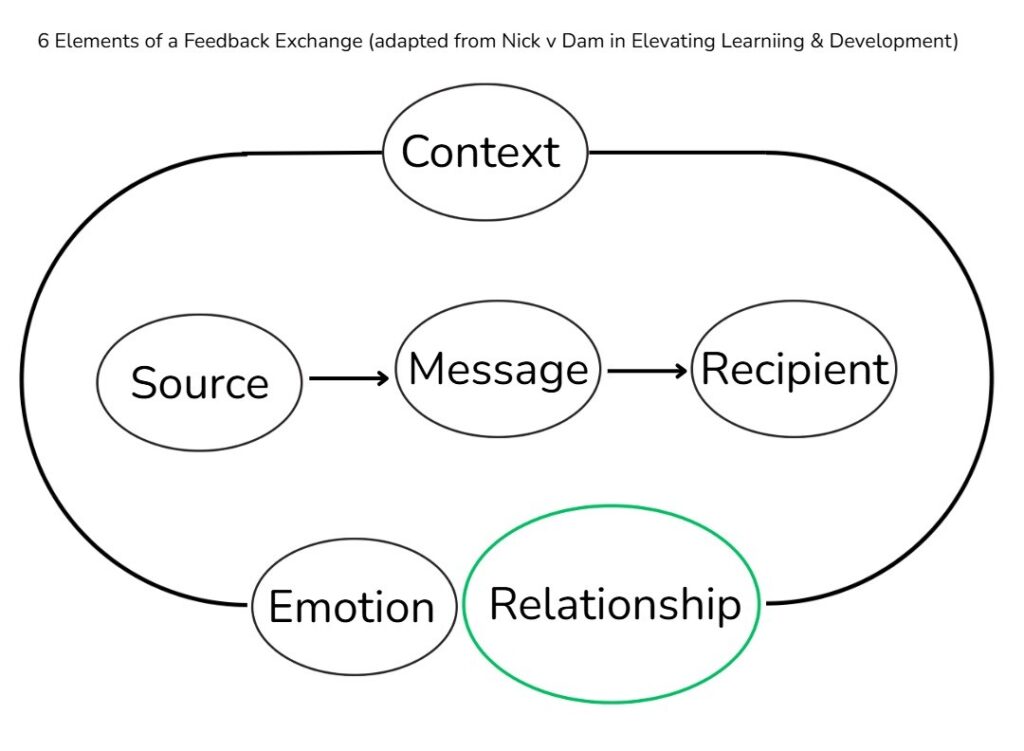
Years later I came across the 5 Elements of a Feedback Exchange in Nick van Dam’s book Elevating Learning and Development. He adapted the model from Gregory & Levy (Using Feedback in Organizational Consulting). Their original framework included four elements — Context, Source, Message, and Recipient. Nick’s adaptation added Emotion, which I find essential. Too often we skip or ignore the emotional side of feedback.
And I’d propose one more: Relationship. Feedback can strengthen relationships when given skillfully — but without a foundation of trust and respect, it can easily spiral into something destructive.
This is why I recommend taking a coaching stance when giving feedback. Coaching creates space for inquiry and mutual learning, instead of the one-way “download” that feedback often becomes.
In the context of my old boss’s message, our relationship was the key. Painful in the moment, yes. But it led to change, learning, and growth.
If you’d like to know more about building the relational skills of human collaboration — or specifically about the peer coaching element of Skillful Collaboration — let’s connect.