I believe in the power of teams, and I believe in learning.
These are two of my core principles as a team coach.
They guide the way I work (and live) with teams and their leaders.
I also believe that when I show up at my client organizations with a combination of these two beliefs — the power of teams and learning — it becomes a powerful recipe for creating real value for both the organization and the people within it.
Leaders, of course (hopefully) lead. But it is teams the really deliver and hence create real value.
I recently read the wonderful book Power and Love by Adam Kahane. In it, he draws on Paul Tillich’s definitions of both concepts:
- Power is “the drive of everything living to realize itself, with increasing intensity and extensity.”
- Love is “the drive towards the unity of the separated.”
These definitions are powerful when applied to individuals. How can I lean into both ‘my power’ and ‘my need for connection.’ But I believe the possibilities become even more powerful when we apply them to teams…
Looking first to Power, What are teams ‘driving’ to realize together? How can we support teams and their leaders to have conversations about this?
Then looking at love: when teams learn together, I also see a strong connection with Tillich’s definition of love. Team members remain individuals, but through working and learning together, they move towards greater unity.
In his book, Kahane argues that we need to embrace both power and love individually and collectively. Most of us have a natural preference or tendency for one — and often a bit (or a lot) of an allergy to the other. I especially enjoy his metaphor for ‘Power and Love’ of walking on two legs: if we rely only on one, we end up hopping rather than walking steadily. Kahane shares stories from decades of facilitating in geopolitical crisis situations, describing how he has developed his own individual capacity for both power and love — sometimes falling, sometimes stumbling, and gradually learning to walk; this to enable people to ‘realize themselves’ and to ‘become united’.
This learning journey for individuals and for teams is certainly not linear. And that brings me to the work of Jennifer Garvey Berger. I am currently reading the second edition of her brilliant book Changing on the Job.
She writes that learning can be about acquiring a new skill or knowledge base. We recognize this in work and in life: the excitement of learning something new, followed by the need for practice if we are to truly become skillful.
She then distinguishes this from development, particularly adult development, which she describes as the growing or expanding our way of making meaning — the “form of our mind,” as she puts it. This kind of development can transform us but it is messy and complex and certainly is also not linear. As individuals, we move forward, we fall back, we plateau, and we grow again (maybe). It is deeply human and there is no certainty.
And this brings me to Team Development.
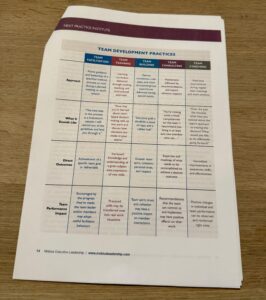
My belief in the power of teams and in learning leads me inevitably here. Teams are the living organisms that create value in organizations. When teams learn together, they become more united. When they practice what they learn, they become more skillful. And as they become more skillful, they create the conditions for real development — both individually and collectively — and for genuinely transformational work.
In our complex world, this work on the complexity of team development excites me deeply.
In our highly individualistic world, we invest enormous energy and resources into Leadership Development. Of course we need to keep investing in our Leaders.
But my call to action is this:
Let’s also invest seriously in Team Development.
Because this is where I believe the real potential of power, love, learning and development lies in our organizations.