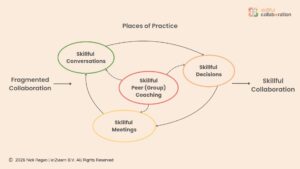
In the previous post we explored how the Dialogic Actions help teams create more Skillful Conversations. Teams become more aware of how they are talking and listening and thinking together and begin to recognize the conversational patterns that either help or hinder the quality of their interactions.
But conversations alone don’t create value.
Teams create value through the quality of the decisions they make together.
Whether it is deciding on strategy, priorities, investments, resources or simply agreeing the next steps of a project, organizations, leaders and their teams are constantly making decisions. Some are straightforward, others are highly complex, but almost all of them are shaped by the quality of the dialogue that happens before the decision is made.
So, what changes when true dialogue becomes part of the decision-making process?
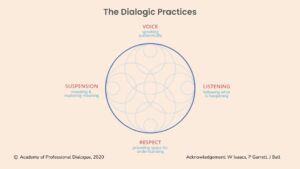
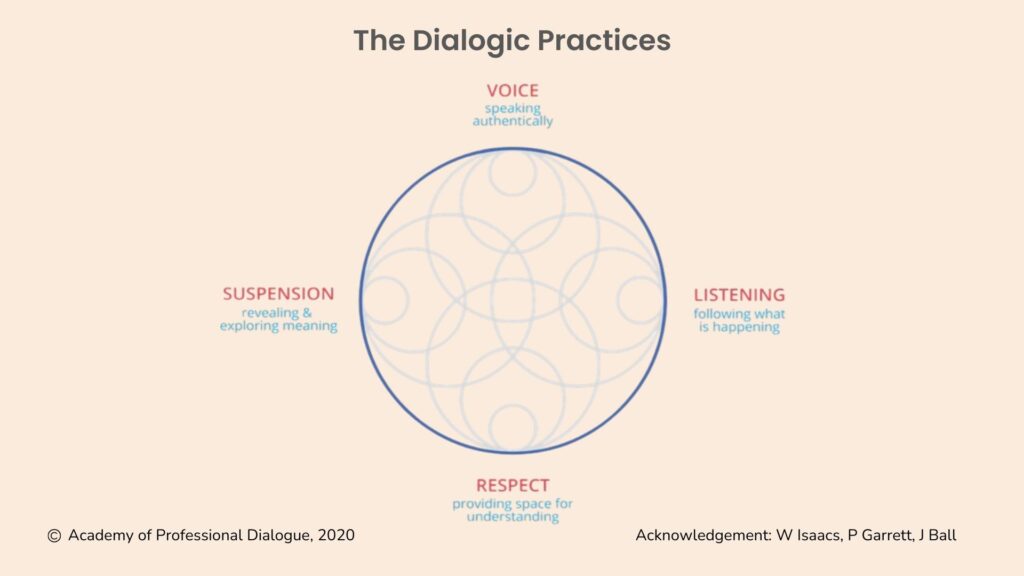
As teams move from Skillful Conversations into Skillful Decisions, they discover that Dialogue goes one level deeper. The Dialogic Actions remain important, but they gradually become internal ways of being as well as spoken ‘Actions’ within a conversation. This is where we begin working with the Dialogic Practices.
One of the first shifts teams experience is between making a Move, by sharing an idea or proposal, and Voicing their thinking. At first this can seem like a subtle distinction, yet in practice it changes the quality of the conversation. To Voice comes from a place of consideration and authenticity. It requires the confidence to share our ‘live’ thinking. Typically in conversation people are sharing ‘thoughts’ or ideas they arrived with, when Voicing we are thinking aloud and creatively. We are also remaining open to the possibility that our thinking may evolve as the team / group continues the conversation. There is an art to knowing or sensing when to Voice our thinking, how to express it clearly and how to leave enough space for the team to continue thinking together.
Listening also begins to take on a different meaning. How often when making team decisions are we genuinely listening to understand another person’s perspective? More often than not we are listening whilst preparing our own position, response or waiting for the opportunity to contribute our own ideas. When in Dialogic Practice, Listening becomes much broader than simply hearing another person’s words. It is about paying attention to what is happening throughout the team. It is noticing our own thoughts, thinking, emotions, intuitions and assumptions as well as those of others. It is remaining curious enough to ask, “What am I not yet seeing?” before deciding that I already understand.
One of the most interesting observations I see in teams is their relationship with saying No. Many people hesitate to challenge another person’s thinking because they fear creating conflict or damaging relationships. Others experience disagreement as something personal rather than something that helps improve the quality of the team’s thinking. Yet, if nobody is prepared to challenge an idea, how can the team know whether it has really found the best direction?
As teams continue learning and practicing Dialogue, something interesting begins to happen. Saying ‘No’ gradually becomes less about rejecting another person’s opinion and more about creating space to understand whether the team has found the best possible direction. Within the Dialogic Practices this subtle shift is reflected in the movement from Oppose towards Respect. Respect is about partnering with ourselves and the team on an equal level, it’s about understanding our own needs and those of others. It’s about slowing down the decision making process to make space for different perspectives. Sometimes Respect may still require a strong No, but it is a No offered in service of better understanding rather than simply winning an argument.
Of all the Dialogic Practices in our modern world, Suspension is perhaps the one teams find most difficult. Organizations, teams and their leaders are under constant pressure to move quickly, solve problems and find answers. There is a permanent pull towards action and resolution. Yet how often do we solve the symptom of a problem rather than understanding the real issue? Suspension invites teams to take the time they really need. I often think of a hanging Calder sculpture when thinking about Suspension and how the artwork can rotate and / or we can move around it in a gallery, we can do the same with problems. It creates space to explore the meaning behind the words / ideas, to question assumptions and to understand the real issue and why it matters before deciding how to approach it and what to do about it. Rather than slowing decisions down unnecessarily, Suspension often helps teams avoid making the wrong decision too quickly.
As teams begin learning and experiencing these Dialogic Practices, the quality of their decisions gradually changes. Decisions become less about convincing others and more about thinking together. Team members begin to feel heard, different perspectives are explored more fully and commitment to the final decision becomes much stronger because people understand not only what has been decided, but why and how they will move forwards together.
As teams become more intentional about the quality of their decisions, another realization naturally follows.
Decisions don’t happen in isolation.
They happen in meetings.
Which raises the next question for our next post.
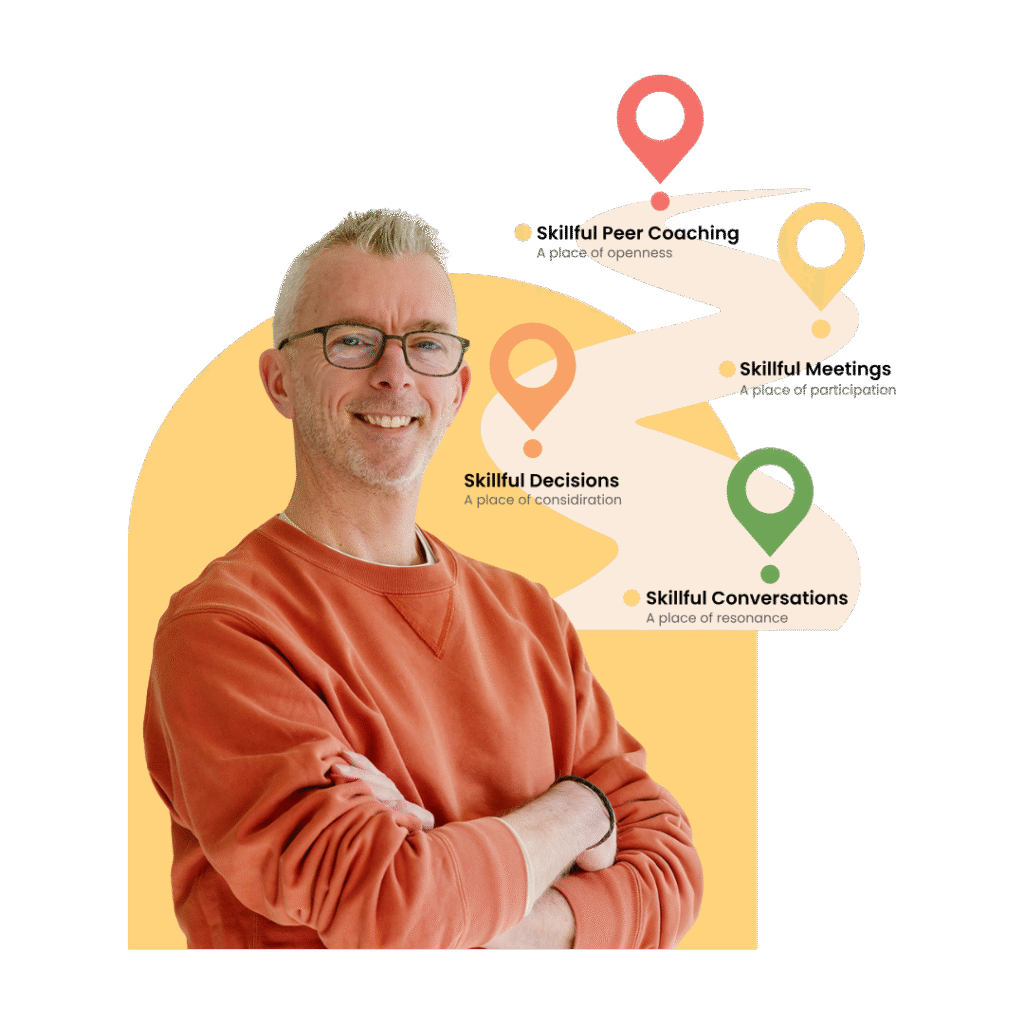
If Dialogue can improve the quality of our conversations and the quality of our decisions, how might it also improve the quality of our meetings?
That is where the next step of the Skillful Collaboration approach begins.