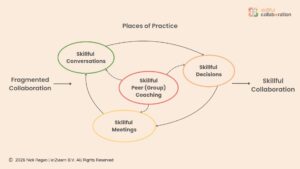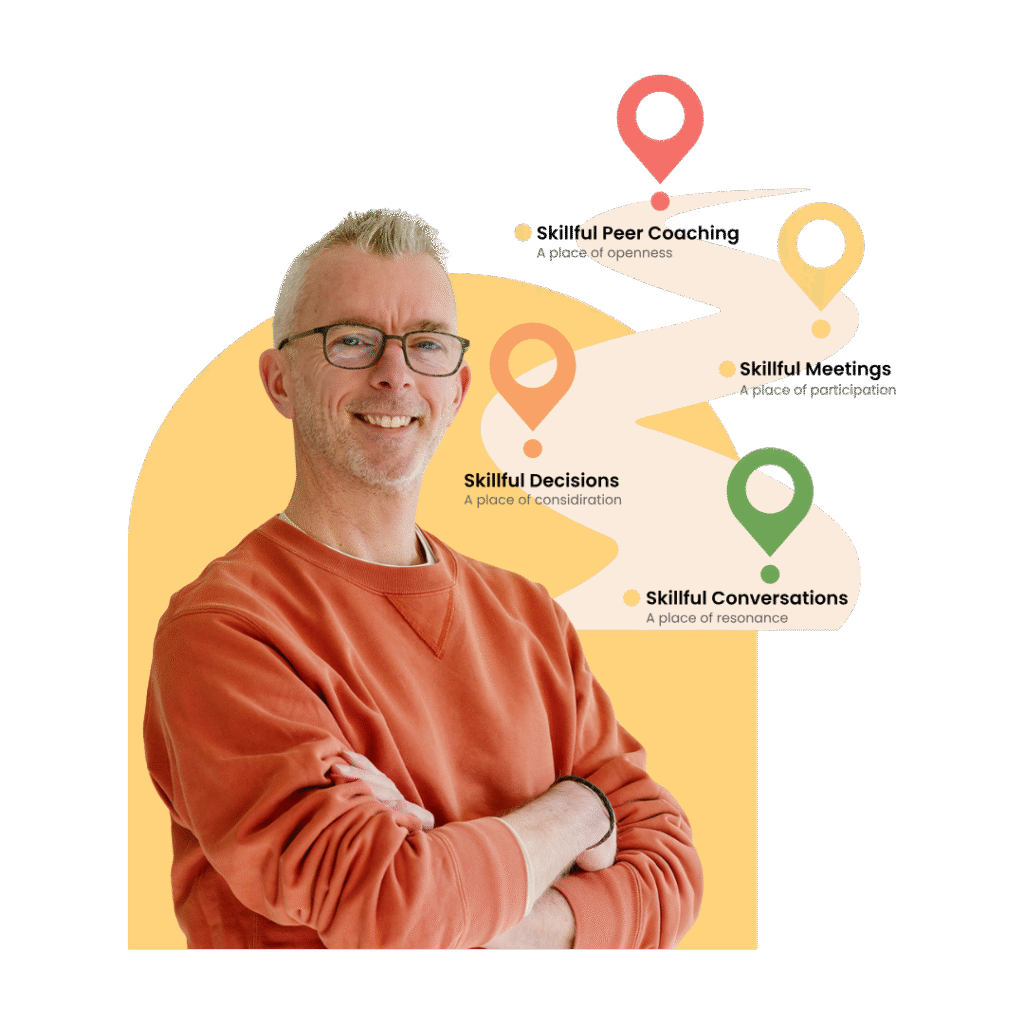
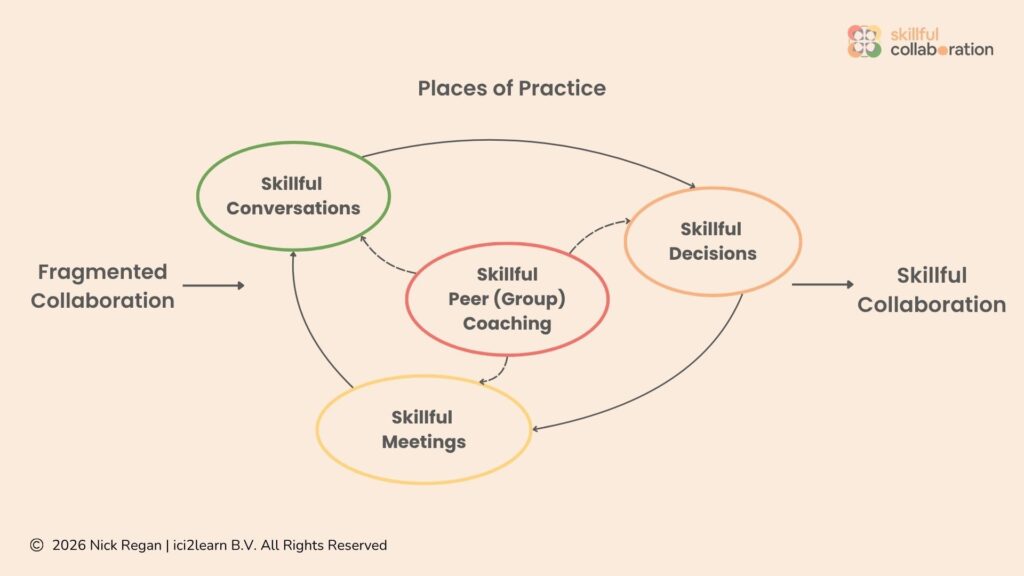
When learning about our Skillful Collaboration approach, teams and their leaders develop the skills of Dialogue through practice in conversations, decisions and meetings.
We define a ‘skill’ as something that can be developed through intentional practice.
Teams first learn the models and skills in our experiential workshops (Skillful Conversations / Skillful Decisions / Skillful Meetings) and then as they collaborate every day doing their jobs, so they can (in principle) practice and develop these skills every day. Through this every day practice, their Dialogic skills improve, enhancing collaboration inside and across teams which has a direct and positive impact on productivity, effectiveness, performance and engagement.
But there is one final ‘step’ of the Skillful Collaboration approach, that we see as an accelerator to further improving the team effectiveness as the teams work together during their conversations, decision making and meetings. The skills in this final ‘step’ can be used in stand-alone 1:1 peer conversation, guided peer group sessions AND they can be used ‘live’ during conversations, when making decisions and during meetings.
The final ‘step’ is : Peer Coaching and Peer Group Coaching.
Peer coaching is about mutual learning together with a peer about ourselves and each other in a 1:1 coaching conversation.
Peer Group coaching is about mutual learning from ourself and with others in a Sub Group or Team coaching conversation.
Following the Skillful Collaboration approach, the intention here is NOT that each team member and team leader ‘becomes’ a professional Coach or Group / Team Coach. The aim is that they understand practice Peer and Peer Group Coaching Conversations with a focus on mutual learning.
One of the first things teams normally notice during initial Peer Coaching conversations is how quickly they move into giving advice or advocacy.
One Peer explains a challenge and almost immediately the Peer Coach offers a solution or a fix to the challenge. And normally this is with the very best intentions. After all, organizations reward people for solving problems and sharing expertise. Yet Advocacy can in fact close down thinking rather than opening it up. The conversation becomes more closed, comparing my experience and ideas versus yours, rather than open with curiosity to learning and experience emergent, new thinking.
Leaning skillfully into the Dialogue Practices invites teams and their leaders to learn about Peer Coaching.
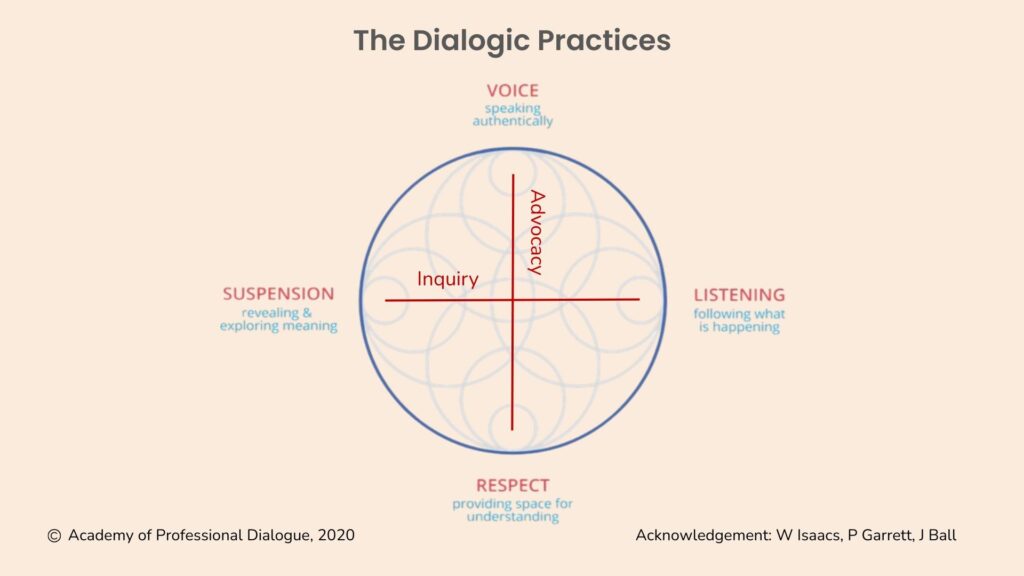
When hearing about the challenge of a peer, instead of ‘advocacy’, “Here’s what should you do!”, a Peer Coaching approach invites ‘inquiry’ and “How can I / we help you think more deeply about your context, situation and challenge?”
That subtle shift changes the quality of the Coaching conversation. Team members and their leaders / Peers begin to notice when they are advocating their own ideas rather than becoming curious about someone else’s thinking. They experience the difference between telling and inquiring, between offering answers and creating understanding / new thinking.
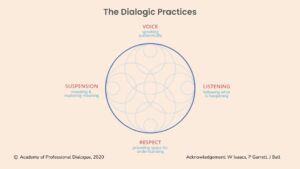
When looking at the Dialogic Practices; Voice, Listening, Respect and Suspension, Peer Coaching has a really focus on Listening and Suspension along the line of Inquiry. Listening to truly follow what is being said and suspending to reveal more from the person being coached. When done skillfully this empowers the peer being coached and can lead to resonant supportive relationships.
Peer coaching therefore has much less focus on the line of Advocacy. However, a Peer Coach may also use their Voice, to mirror back what they are hearing or to appreciate or champion an idea / behavior that the Peer being coached has been talking about.
Also they may Respectfully oppose, for example, if asked by the Coachee to also share their ideas on the topic.
The balance from the Peer Coach is to mostly lean into and practice the Dialogic skill of ‘Inquiry’, to listen with genuine curiosity, to respect different perspectives and to suspend judgement long enough for new thinking to emerge from the coachee.
None of these skills are learnt by talking about them. They are learnt through repeated practice.
In terms of applying the Peer Coaching skills into a Peer Group Coaching space, the Skillful Collaboration approach proposes a Peer Group Coaching process.
Our process invites one peer or the team leader to brings a ‘live’ issue and to be coached by a sub group or full full. In this facilitated process, the topic / issue is clarified through a round of inquiry, the coachee states what they are requesting from the group, the group will share their experiences but it is the coachee who will reflect and decide what to do with this information and will clarify what they will do for next steps about the issue, then finally the whole group will share what they have learnt from the process.
This is a dialogic process with each Peer in the Group given equal space to share both their Voice and their curiosity, but the ownership of the challenge remains that of the peer being coached.
Again our Peer Group Coaching process is really focused on first leaning into Inquiry and secondly holding space to share your authentic experiences and learning without really advocating a position.
The above explains how Peer Coaching and Peer Group Coaching can be held in stand alone session, but over time and as the Coaching skills improve, they becomes much more than separate developmental activities. They becomes skills that can be called upon during Conversations. They allow Meetings to become more thoughtful and decisions become more rigourous and robust because the team is developing the skills of inquiry in their everyday work / practice.
In this sense Peer Coaching and Peer Group Coaching aren’t in fact ‘steps’ along the Skillful Collaboration approach. As you can see on the model, they are at its center and help sustain and accelerate the whole learning and development of how the team practice the everyday human skill of dialogue to improve how they collaborate / work together.