Clarifying Decision Authority, Priorities and Escalation Pathways
Why this Matters
Key insight from the programme:
“Effective collaboration depends on knowing not only how decisions are made, but by who they should be made.”
As organisations become more complex, leaders increasingly find themselves working across functions, countries and stakeholder groups. In these environments, collaboration often slows down not because people lack commitment or capability, but because decision authority is unclear.
When ownership is ambiguous, teams can become dependent on escalation, priorities become blurred and accountability weakens. Effective cross-functional leadership requires more than influencing skills. It requires creating clarity about who owns what, where decisions belong and how the wider system works together.
Challenge
A group of Sales Leaders had taken on additional responsibilities as Cross-Functional Team (CFT) Leaders within a multinational organisation.
Together they were responsible for leading seven Cross-Functional Teams operating across Europe, Central America and South America.
While they were experienced leaders within their own functions, the CFT role required a different mindset. Success was no longer defined solely by sales performance. It depended on their ability to align priorities, coordinate stakeholders and create collaboration across multiple functions, countries and markets.
As the teams worked together, questions emerged around:
- Who owns which decisions?
- Which priorities belong to the CFT?
- What should be escalated?
- How and when should escalation happen?
As the scale and complexity of the system increased, these questions were creating uncertainty and limiting the effectiveness of collaboration.
The organisation wanted to strengthen both Effective Collaboration and Holistic Leadership by helping leaders better understand their role within the wider system.
Approach
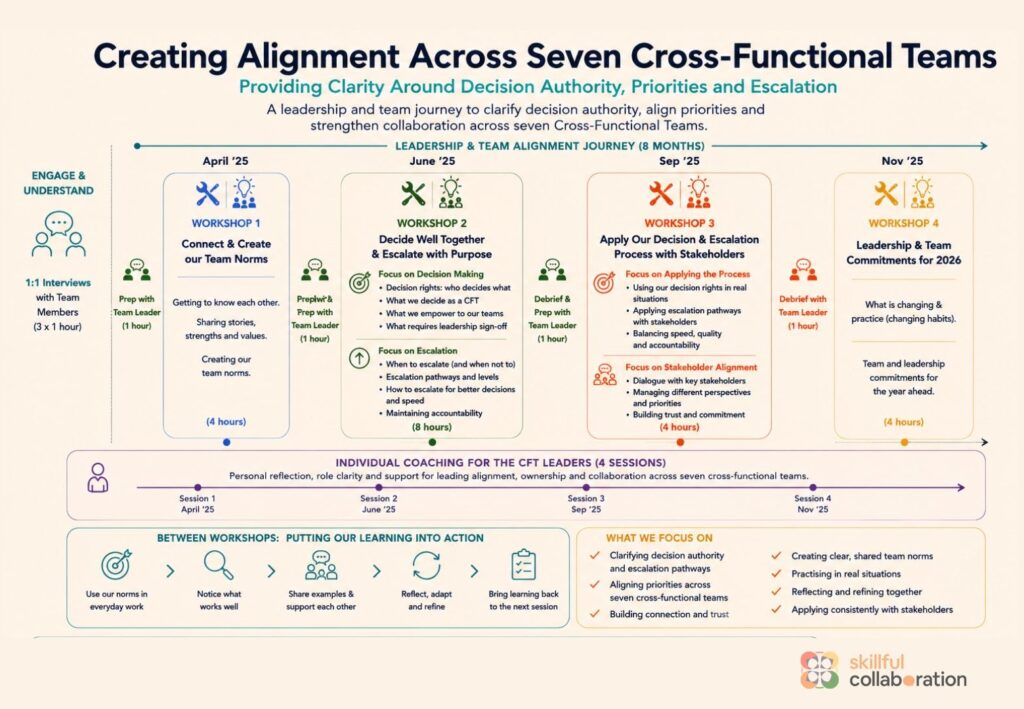
The development journey focused on Holistic Leadership and Effective Collaboration and combined individual coaching and a series of workshops and reflection sessions over a period of 8 months.
The programme began by exploring how the teams currently worked together. Leaders reflected on team behaviours, team norms, collaboration challenges and the realities of leading across multiple countries and stakeholder groups.
Particular attention was given to the complexity of coordinating seven Cross-Functional Teams operating across different geographies and business contexts. Leaders explored how local priorities, regional priorities and organisational priorities interacted, and where decision authority needed to sit to ensure both alignment and agility.
A key focus of the journey was decision-making authority. Rather than focusing solely on how decisions were made, participants explored a more fundamental question:
“Where should decisions be made?”
Through structured conversations, practical frameworks and real business examples, the teams clarified:
- which decisions belonged to the CFT leaders,
- which were empowered to the team members,
- which decisions required leadership sign-off,
- when escalation added value without reducing accountability.
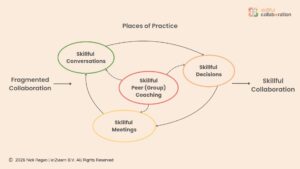
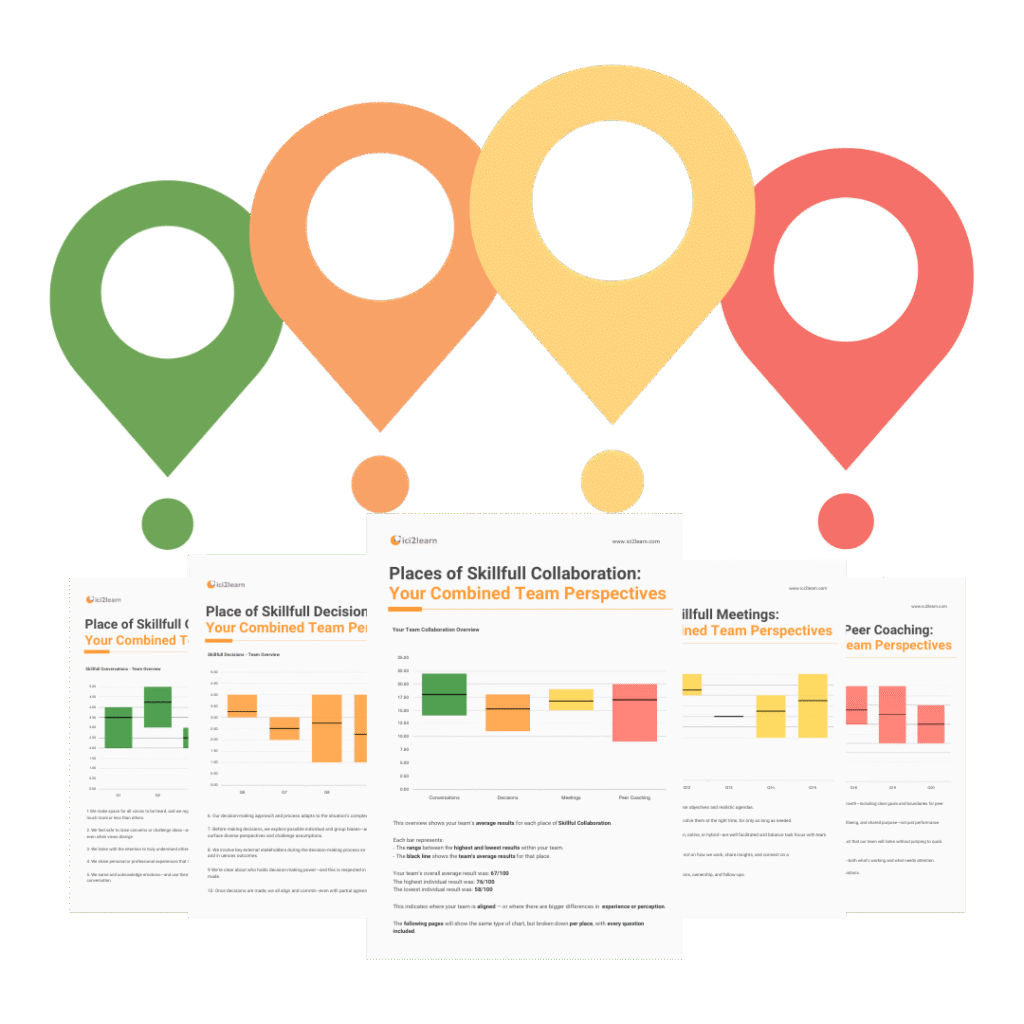
Alongside this work, participants explored Skillful Collaboration practices, including Skillful Conversations, the 7 Modes of Talking and Thinking Together, Effective Meetings and Peer Coaching.
The journey also included individual coaching for the leaders, helping them reflect on their role, leadership style and the challenges of leading beyond their functional expertise.
Reflections
One of the most important insights was that effective cross-functional leadership is not primarily about making more decisions. It is about helping the team leaders and team members within the organisational system make better decisions.
Many of the challenges that initially appeared to be communication issues were actually symptoms of uncertainty about authority, ownership and priorities. As leaders became clearer about decision rights and escalation pathways, they also became clearer about their own role. They recognised that one of their most important responsibilities was creating clarity for others.
The programme highlighted a shift from functional leadership towards systemic leadership.
As Sales Leaders, participants were accustomed to leading within their own area of responsibility. As Cross-Functional Team Leaders, they needed to think beyond their function and consider how decisions affected multiple teams, stakeholders, countries and markets. This required a broader perspective. Instead of optimising for one function, leaders increasingly focused on creating alignment across the wider system.
Instead of asking:
“What decision should I make?”
leaders increasingly began asking:
“Where is the best place in the team or the system for this decision to be made?”
This shift fundamentally changed the quality of collaboration across the teams.
Outcomes
The leaders developed greater confidence and ownership in their role as Cross-Functional Team Leaders and gained a clearer understanding of how decision authority should operate across seven Cross-Functional Teams.
The teams created greater clarity around: priorities, ownership, escalation pathways, decision-making responsibilities.
Leaders also developed a shared language for discussing authority, accountability and collaboration, making it easier to navigate complex situations and align stakeholders.
Most importantly, the leaders began to see their role not simply as driving results within their own function, but as creating the conditions and clarity that enable effective collaboration across the wider organisation.
What Made the Difference?
The programme approached collaboration as a systemic challenge rather than simply a communication challenge.
By helping leaders understand both their own role and the wider decision-making system, the teams were able to strengthen ownership, reduce unnecessary escalation and improve collaboration across functions, geographies and stakeholder groups.
This case illustrates a core principle of Skillful Collaboration:
Great cross-functional leaders do not make every important decision themselves. They create the clarity that helps the right decisions get made in the right place.
Testimonials
The HR Director described the programme as one of the organisation’s key achievements of 2025, highlighting the tangible alignment and clarity created between the CFT Leaders, the Cross-Functional Teams and the board. Additionally she added:
“I’m proud of what we have achieved together.”