How Peer Group Coaching Helps Emerging Leaders Learn and Grow Together
Why this Matters
Key insight from the journey:
“Leadership isn’t learned by having all the answers. It’s learned by thinking through real challenges together.”
Leadership Development programmes introduce useful models, tools and ideas. But the real challenge is helping leaders apply those ideas once they are back at work when working through important, complex relationship issues in their roles and teams.
Most leaders have read a book or two about leadership and can understand the models and the processes. They may even have had some separate training sessions for looking at questions like: How do I build trust? How do I give difficult feedback? What is the right balance between leading and managing?
But these are not questions that can be answered by theory alone or a quick training session. They need to be learned through experience on the job and supported by reflection as leaders are going through the experience.
They need regular spaces for reflection with trusted colleagues. This case study explores how Peer Group Coaching can provide that space.
Challenge
A group of emerging leaders from a multinational FMCG company had begun a broader leadership development programme. Alongside the skills based workshops, we wanted to create regular opportunities for leaders to apply the learning to real situations they were facing every day.
Rather than relying on the facilitator for answers, the ambition was to build a learning community where leaders could think together, challenge one another and learn from one another’s experience.
As part of the programme, the leaders meet for six facilitated Peer Group Coaching sessions, creating an ongoing rhythm of learning, reflection and practice.
Approach
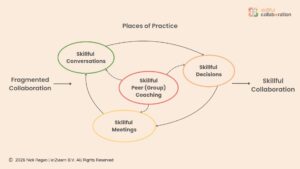
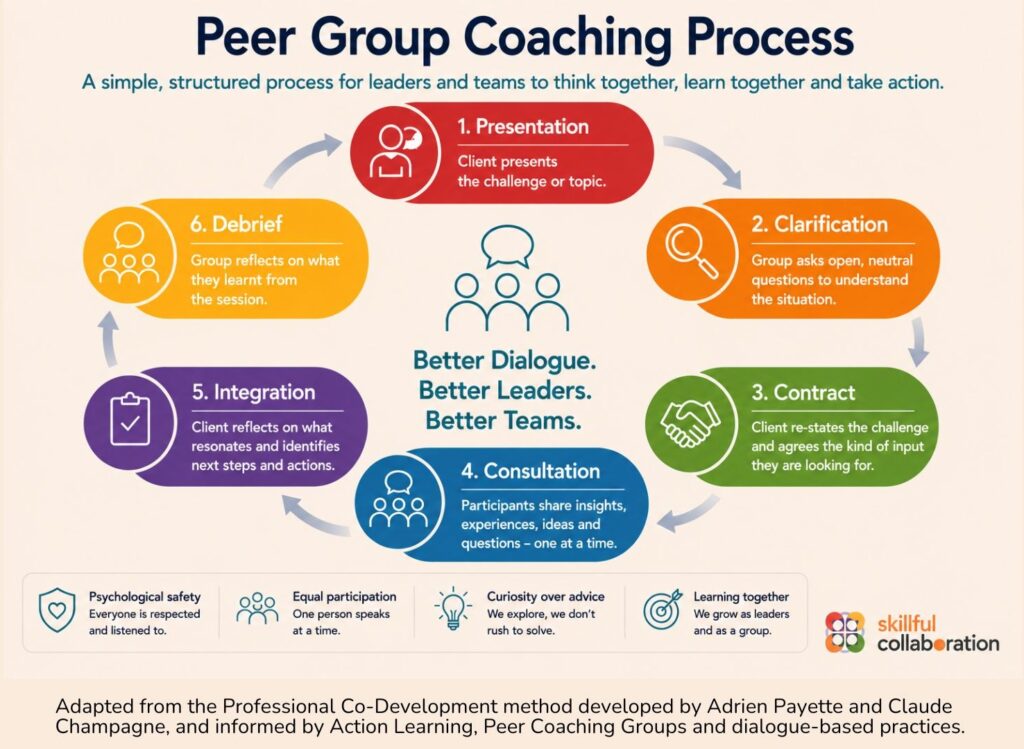
The sessions use the Skillful Collaboration Peer Group Coaching process, adapted from the Professional Co-Development method developed by Adrien Payette and Claude Champagne, and informed by Action Learning, Peer Coaching Groups and dialogue-based practices. Each session centres around a real leadership challenge brought by one participant.
To protect confidentiality, the examples below are representative of the kinds of leadership challenges explored during the sessions.
Typical topics included:
- How do I balance support and accountability within the team.
- How can I build a stronger connection across other functions.
- How can I delegate more effectively and not get pulled into the details.
The process is deliberately simple but the conversations often go deep. One leader (the client) presents their challenge or issue. Then the group asks questions to better understand the situation. The client then contracts with the group, re-clarifying their issue and naming the kind of support they would find most valuable. Only then do colleagues begin sharing observations, experiences, ideas and different perspectives, as ‘the client’ listens in. Finally, the client reflects on the conversation, identifies what they will take away and commits to practical next steps.
Each session finishes with a short debrief, where the group reflects not only on the leadership challenge but also on what they learned for themselves about coaching, listening and collaborating together.
Reflections
One of the biggest insights was that everyone learns, not just the person bringing the challenge. Although each conversation focused on one leader’s situation, everyone found themselves reflecting on their own leadership.
Comments during the debrief included:
- “The quality of the questions changes the quality of the conversation.”
- “I need to create more ownership instead of solving problems myself.”
- “Slowing down to clarify the question will really helped me make better decisions.”
- “Balancing the tasks and the relationships whilst staying true to myself,,, Wow, leadership it’s sometimes difficult.”
Perhaps the biggest learning was that the collective intelligence of the group was far greater than any one person trying to solve the problem alone. And the feeling of togetherness, with both support and challenge is like a breathe of fresh air for the leaders who vulnerably show up with their topics.
Outcomes
The sessions became much more than an opportunity to solve individual leadership challenges. They created a community where leaders could learn with one another, practise coaching skills and become more comfortable exploring difficult situations together.
Several participants also recognised that the same process could help their own teams think through challenges together, creating a practical way of building coaching and collaboration into everyday work.
What Made the Difference?
Many leadership programmes finish when the workshop ends. These Peer Group Coaching sessions created a regular space where leaders could continue learning by bringing real work, thinking together and supporting one another.
Over time, the group wasn’t just developing better leaders. They were developing leaders who knew how to help others think more skillfully too. Leadership is rarely about having all the answers, it’s about creating the conditions and conversations where better answers and mutual learning can emerge together.
Testimonials
As one participant reflected:
“I learnt such a lot and will start practising this process with my team and my colleagues.”