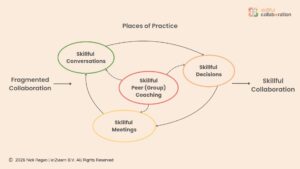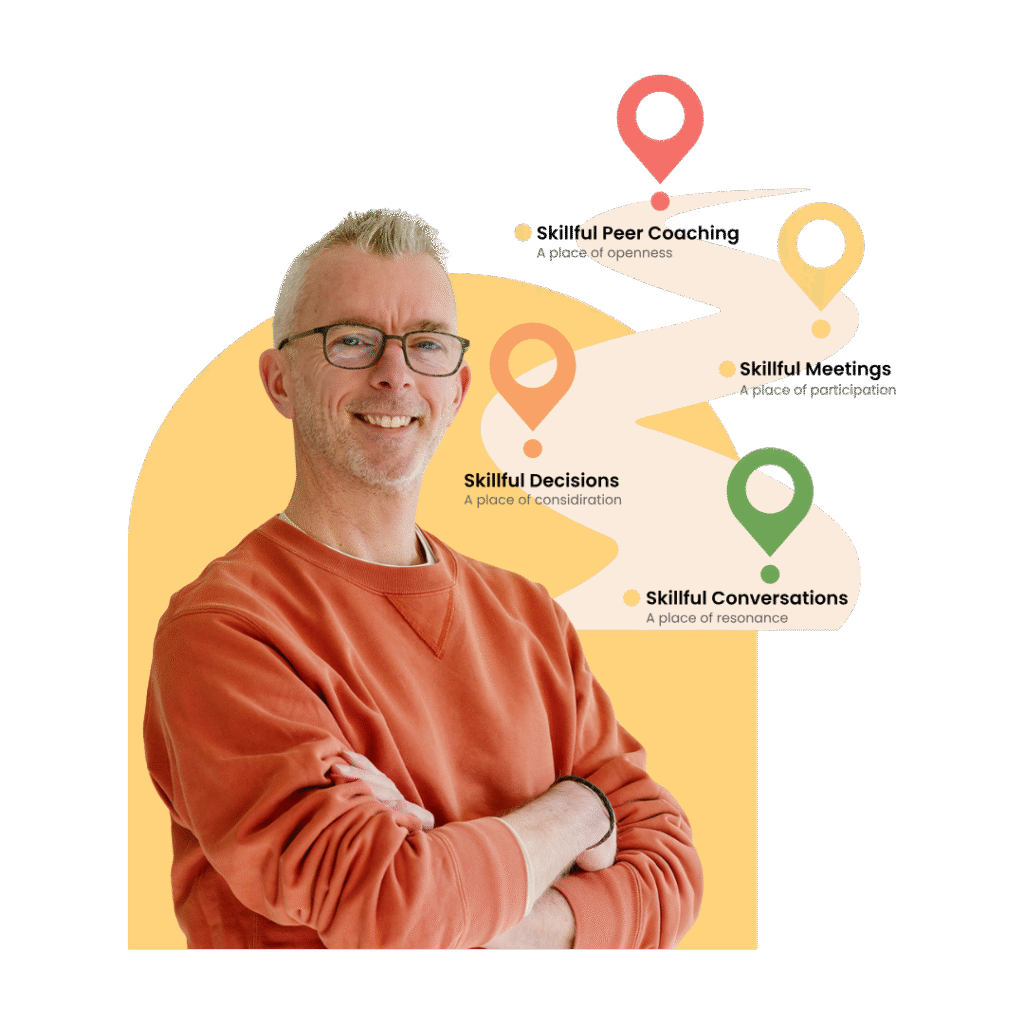
In the previous post I explained that the Skillful Collaboration approach is built upon the principles of Dialogue, which can be intentionally practiced and woven into four everyday human interactions in our work places. The first of these interactions is Skillful Conversations.
Every team has conversations every day. They happen informally ‘one-to-one’ over coffee, in small groups, in project meetings, and in the board room with leadership teams. Yet, whilst every team has conversations, not every conversation is ‘skillful’ or helps the team talk and think together or move forwards together. Most conversations in teams have recurring patterns based on culture, power dynamics, personal and inter-personal preferences and biases.
So, where do we begin to make conversations ‘skillful’?
One of the first things teams learn is that not all conversations serve the same purpose. We raise the awareness that sometimes we need to share information in the form of monologue. Sometimes we need to debate different perspectives. Sometimes we need to explore possibilities together before deciding on a direction. Becoming aware of these different ways of talking and thinking together is the first step towards becoming more intentional in our conversations.
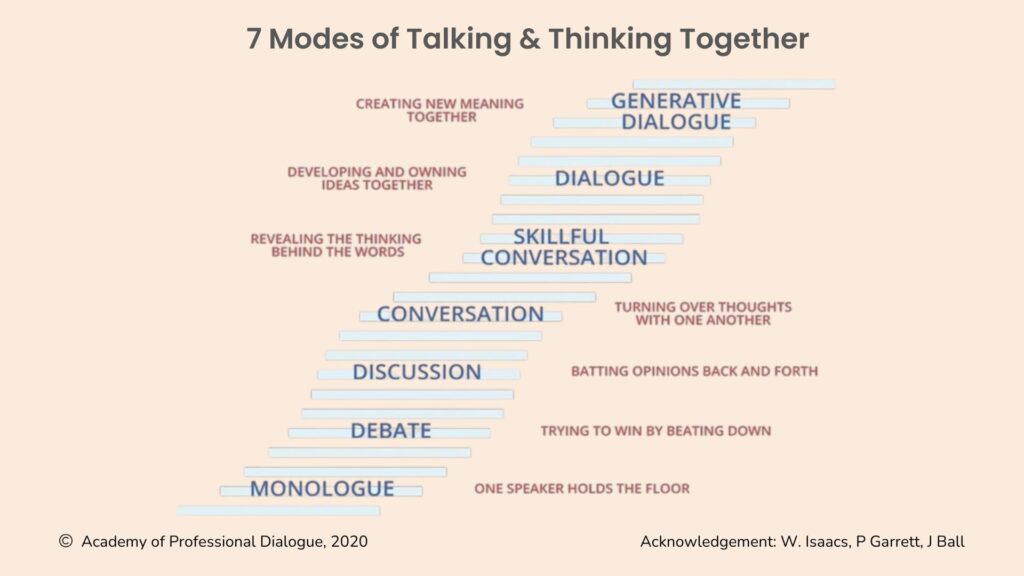
We therefore begin by exploring and experiencing the 7 Modes of Talking & Thinking Together.
Each mode has enormous value inside teams, across teams and throughout organizations. However, like any skill, when a mode is underused, overused or used without intention, much of its value is lost.
For example, how many times have you witnessed an argument between colleagues from different departments that could more skillfully have been addressed as a debate? Both people are trying to win, neither is really listening, and each new sentence simply an interruption of the other in an attempt to reinforce their own position. Imagine instead that each person genuinely listened to understand the other’s perspective before building their own argument. Or imagine asking the two people to swap sides and argue for the position they had been opposing only moments before. Suddenly the energy and empathy changes. New thinking begins to emerge. These are the type of possibilities that begin to open up as teams become aware of the 7 Modes of Talking and Thinking Together.
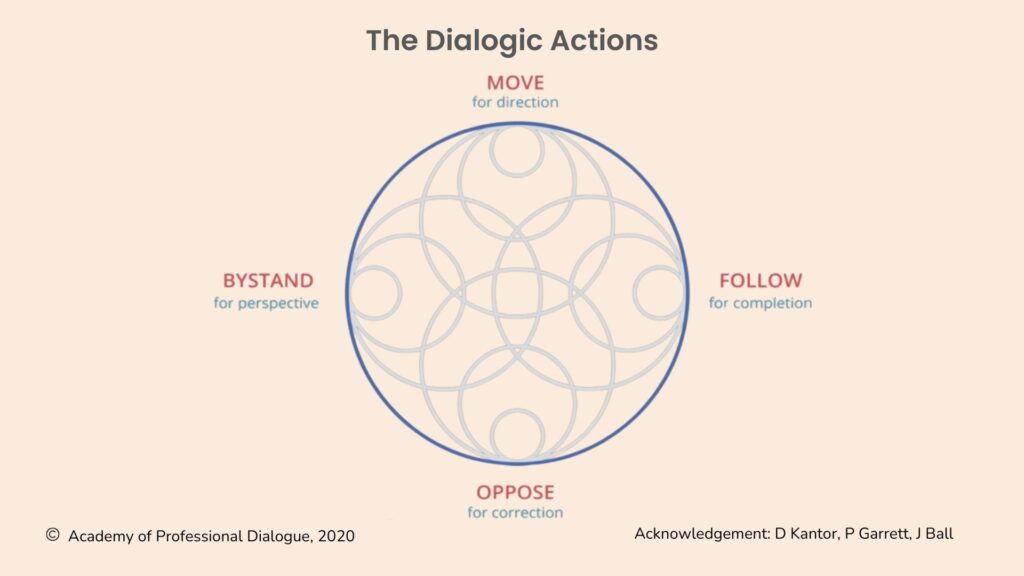
Once teams have experienced the different Modes of Talking and Thinking Together, we move into what is the real foundation of a Skillful Conversation, the Dialogic Actions. Originally created by David Kantor as the 4 Player Model and further developed for teams and groups by Peter Garrett and Jane Ball, the Dialogic Actions help teams become aware of the habitual patterns that are constantly unfolding within their interactions / conversations.
How many times have you been in a team or cross functional team meeting where one person makes a proposal, another immediately offers a different idea / proposal and then somebody else jumps in with what they believe is a compromise? At first glance it feels like a productive conversation because everyone is contributing. Yet, when we slow the conversation down, we often discover that nobody has really explored or built upon the thinking that has already been shared. The conversation has simply become a series of Moves.
A Skillful Conversation does need people to make a Move, create proposals. Without new ideas a team cannot create direction or make decisions. It also needs others to Oppose i.e. Say ‘No’ to those ideas. Without Oppose, teams naturally drift towards agreement, group think develops and better possibilities can easily be missed. In Dialogic Actions, Oppose is not about conflict or winning an argument. It provides correction for the conversation. It says, “Let’s explore another possibility,” or, “Let’s see whether there is an even better direction.” It also requires emotional maturity because saying No can be uncomfortable, both for the person speaking and for those hearing it.
One of the most challenging Dialogic Actions for many teams is Bystand. Rather than becoming absorbed in the content of the discussion, Bystand invites someone to ‘step onto the balcony’ and observe what is actually happening in the conversation. They may notice that three different proposals have already been made without any real exploration. They may notice that one voice is dominating whilst others remain silent. Or they may simply ask an open question that helps the team become curious about its own thinking.
Also, Skillful Conversations require Follow. This is how team members openly commit and agree to moving forwards together. It creates clarity, commitment and shared accountability. How many times have you left a meeting believing that a decision had been made, only to discover a week later that very little has actually happened? Often this is not because people disagreed with the decision, but because nobody or not everybody clearly followed it.
Skillful Conversations are enormously valuable in organizations because they create the conditions for teams to be aware of their current patterns and then start to practice how to actually think together rather than simply talk together. Using the Dialogic Actions can become the foundation upon which shared understanding, direction and commitment are built.
In summary, the 7 Modes of Talking and Thinking together creates awareness that intentionally choosing the appropriate mode of team interaction can open up real possibilities. And by specifically leveraging the Skillful Conversations mode, enables teams to make more rigorous and collective decisions.
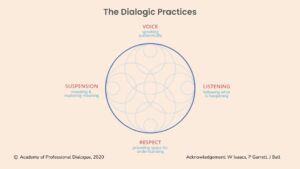
However, to go one step deeper to make Skillful Decisions, teams need to learn about the skills of Dialogic Practices. More of this in the next post.